https://t.me/Hack_0xTeam
https://t.me/Hello_root ]]>
https://t.me/Hack_0xTeam
https://t.me/Hello_root ]]>
Smørrebrød is a piece of Danish cultural history. Its story is a fairy tale about how a simple everyday food was elevated to a coveted delicacy, gained worldwide fame, went out of fashion, then revitalized itself on its 100th birthday in order to achieve greater renown than ever before
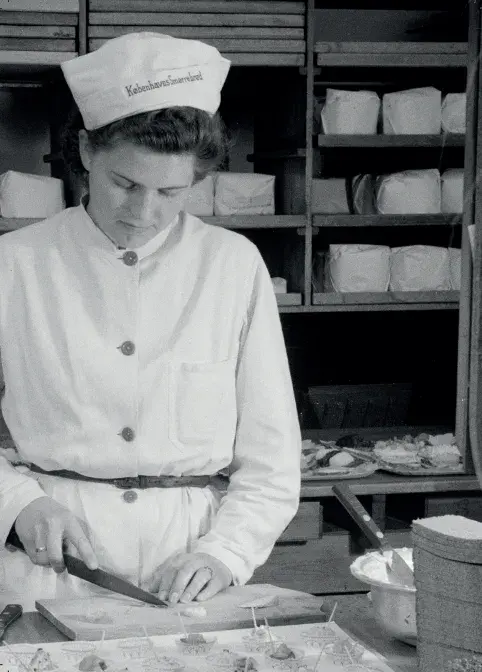

Smørrebrød begins with bread. Usually, this is ‘rugbrød’ – or ‘rye bread’ – that also has a history in other European countries: from Norway, down to northern Italy, and east to Russia. We have the bread in common, but smørrebrød as a culinary speciality is a uniquely Danish phenomenon, and it has been with us since the Viking Age.
Archaeological excavations have shown that the Vikings ate bread and butter, but they left no written records of their diets. However, an Arab named Ibn Fadlan did. In 920, he was sent by the Caliph in Baghdad to observe the Vikings. He describes the food of the Vikings with some scepticism. He calls their favourite drink, mead, disgusting and wonders why the Vikings seem to prefer boiled meat to fried.
Bread was unleavened until the Viking Age, but the Vikings discovered sourdough and used it to develop rye bread, which is probably what is described in the Hákonar saga Hákonarsonar from 1250. The saga tells of a journey in which the weather was so cold that you could not spread butter on bread; instead, you had to bite the butter and the bread in turn.
In the following centuries, the Danes had rye bread as one of their most important sources of nutrition. Everybody ate it, but nobody paid it much attention. According to the earliest written source to mention it– theatrical plays by the important Danish writer Ludvig Holberg – rye bread was the food of the common people.
Holberg may well have eaten at some of the restaurants that to this day serve smørrebrød, such as Café Gammeltorv, which was founded in 1671 shortly before he was born. Holberg would have eaten smørrebrød of the simple type, for the establishments of the 17th century – inns – were by no means culinary oases. Nor were they, for that matter, in the 18th century, when a pub opened in Fortunstræde 4 where the Slotskælderen restaurant is located today.
Smørrebrød was not very appealing in those days, as was expressed by the poet Johan Herman Wessel’s in his famous verse from this period: ‘That love is not hate, and smørrebrød is not dinner, that’s what I know at the moment about smørrebrød and love,’ – which rhymes nicely in Danish.
This was a poem written in frustration, and there are two different explanations of its meaning. One says Wessel had been invited to a dinner party but served only smørrebrød. The other says that he rejected the bill at a tavern because it mentioned dinner on it even though only smørrebrød had been served.
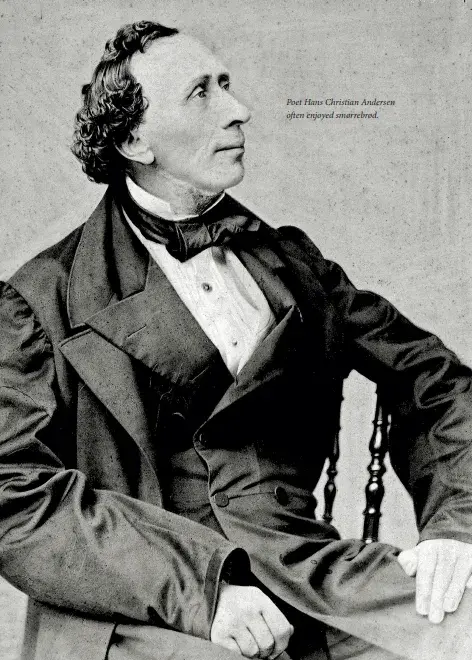
Another poet who commented on smørrebrød was Hans Christian Andersen. He often used smørrebrød as a kind of emergency measure if the food at a dinner party disappointed him, like the meals he ate at the home of the Ørsted family. They often served sweet fruit soup, which was something the poet despised: ‘We had sweet soup and duck; When I went home and was in the middle of Østergade I felt the nervous feeling I always get after eating sweet soup. I got as far as to the Henriques family, my feet wobbled, my hands trembled; I got two servings of smørrebrød and a cup of broth, it helped.’
Similarly, in his old age, Andersen could end up leaving a slightly too lively dinner party to eat smørrebrød alone, as he did in 1874 when he joined company in Holsteinborg but slipped out alone to enjoy ‘smørrebrød and Albani beer’.
The following year, Andersen would take his last breath and leave this world just before smørrebrød turned into a truly adventurous meal. But that’s still around the corner.
Smørrebrød’s major role in Danish food culture is well known, and it has been the subject of fierce passion. One example is found in the newspaper Fatherland. In the 19th century, the paper told the story of a boy, who had set fire to the farm, because the farmer refused him butter on his smørrebrød with cheese.
At the end of the 19th century, Denmark experienced a short gastronomic golden age which brought about the luxury version of smørrebrød. The golden age was sparked partly by the influx of French chefs, who started to gain influence in the newly formed upper class in Denmark. The new class was made up of merchants and industrialists who gained wealth thanks to the strengthening economy, and they were eager to socialise, which to a large extent happened around the dinner table.
Inspired by fine French gastronomy, Danish restaurateurs brought the elaborate style of French cooking to Danish cuisine, thus upgrading the everyday smørrebrød to a luxurious feast.
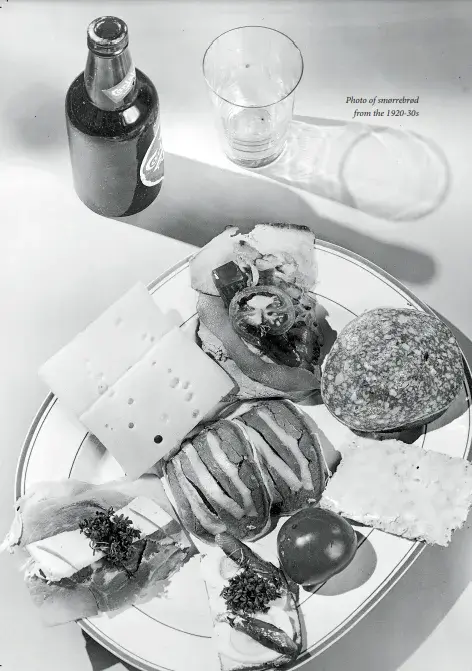
For example, the duck roast and the pork roast came onto the table like neatly prepared pieces of smørrebrød with green salad under the meat and with red cabbage, prunes, and perhaps a slice of the new and exotic orange on top.
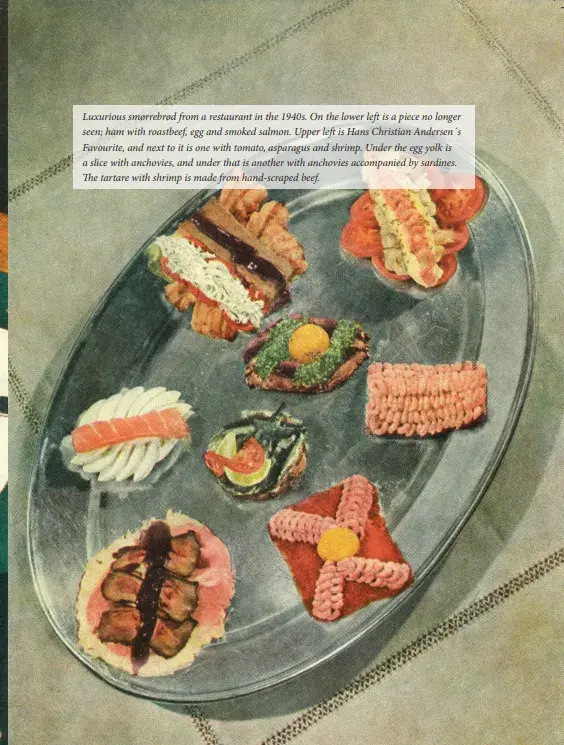
In particular, it was the idea of serving these very exclusive specialities on bread that attracted attention. Placing large amounts of meat on a thin slice of bread made luxury smørrebrød into something that stood out as a sumptuous meal. The prosaic smørrebrød of yesteryear continued to exist as an everyday food, but the luxurious version became more widely available in both new and previously existing smørrebrød restaurants.
Creativity flourished, and the selection grew. With fifty different variants of smørrebrød and as many guests, in any restaurant, a bright idea was developed to facilitate clarity: the smørrebrødsseddel. The smørrebrødsseddel was a printed form for guests to tick off their meal selection and hand to the waiter, an idea most restaurants adopted.
‘The art of smørrebrød is extremely interesting. For the expert, it is very easy to make, for the novice it is very difficult, like for a Dane to learn Greek, Latin or French.’
Axel Svensson, managing director of Oskar Davidsens, 1940s.
Smørrebrød’s status as something of national importance can be understood from an article in a Copenhagen newspaper of 1914, which was about 30 years after the emergence of luxury smørrebrød. The article, ‘Our Smørrebrød’, is a cry of alarm from a journalist upset by the price of smørrebrød in Tivoli Gardens:
‘The other day I was sitting at one of Tivoli’s best-known restaurants and was looking forward to having my dinner in the open air. I asked for a smørrebrød menu and got it. The first thing that caught my eye was a piece of smoked eel for the outrageous price of 0,50 krone and the same for smoked salmon. Of course, I did not ask for these, my favourite pieces of smørrebrød, as they were to be bought at such a crazy high price. It’s time for the audience to vigorously protest the exorbitant smørrebrød prices that all major restaurants are setting. At our restaurants, smørrebrød was once something that was really national. Foreigners as well as Danes delighted in the varied, nicely prepared, and tasty smørrebrød. It brought something festive to the meal,’ the journalist wrote about the modern national treasure, also praised by painters and poets, as shown on the following pages.
The smørrebrød described by Johannes V. Jensen in words, and by Fritz Syberg in paint, is not exactly luxurious, but neither were the type common people had in their everyday life.
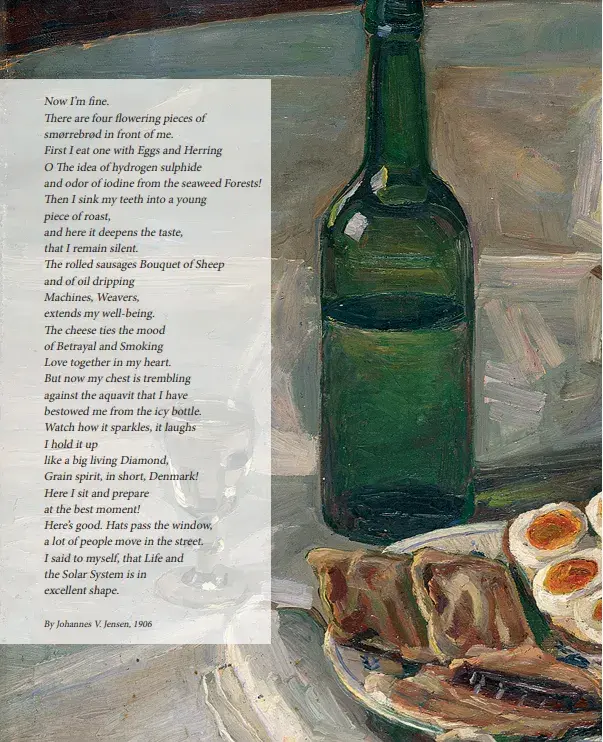
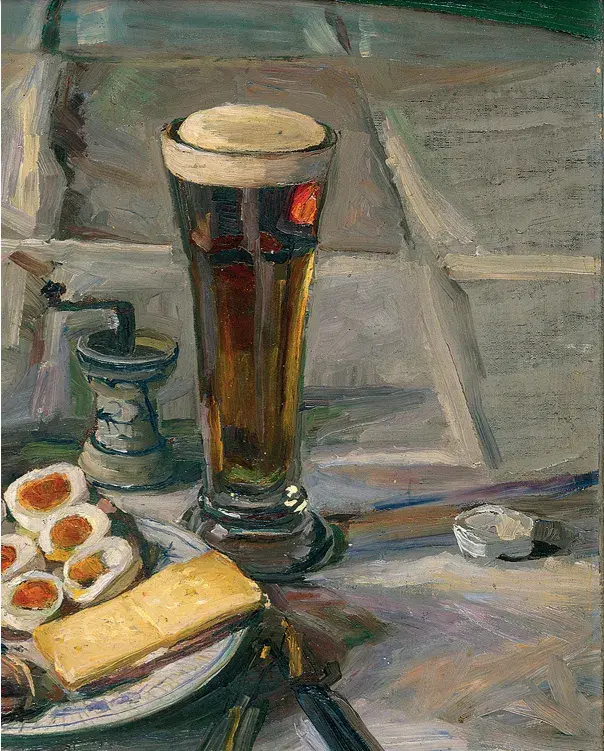
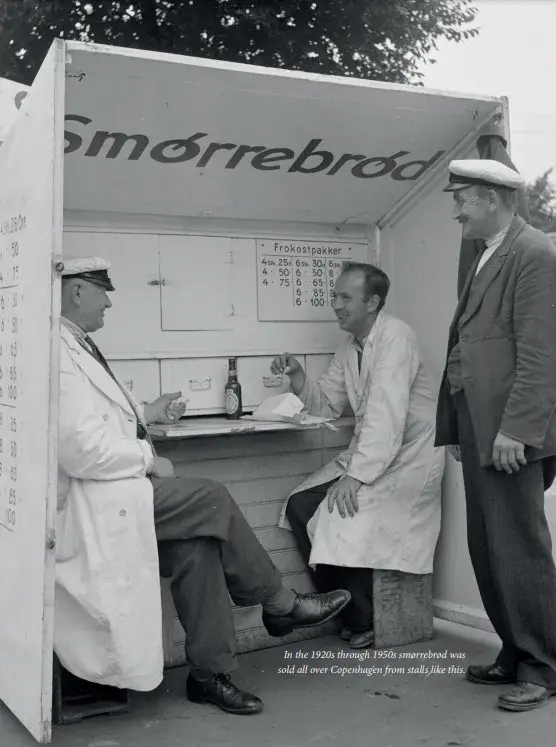
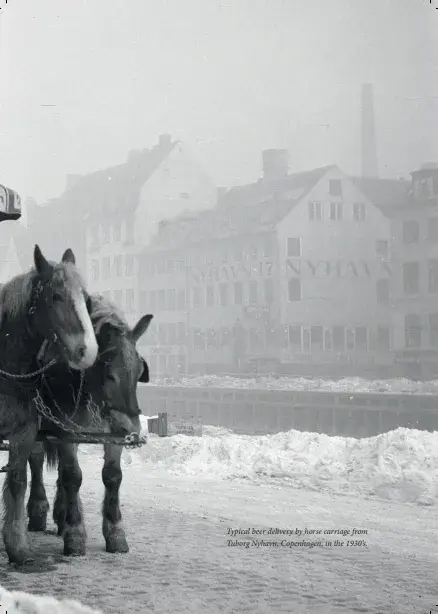
Luxury smørrebrød’s humbler sibling, ordinary smørrebrød, was the fast food of the day. It was sold on the street from horse-drawn carriages, stalls, grocery stores, and butchers, and entire smørrebrød factories arose with some producing up to 100,000 pieces daily.
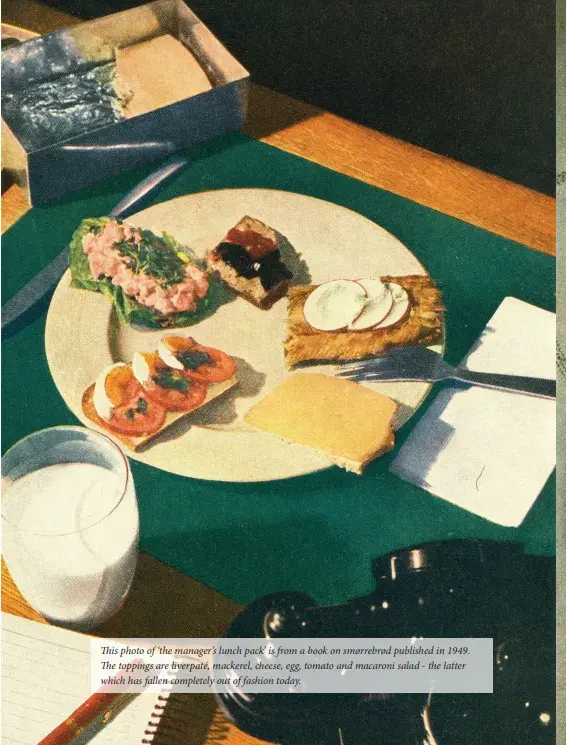
A recipe from that time also show signs of simplicity, it was published in the newspaper Aftenposten. The recipe is for ‘herb salad for smørrebrød’, and it is made from carrot, celery, parsley root, potato, and beets. These are cooked and cut into small pieces, then turned into 40 grams of salad to top the bread.
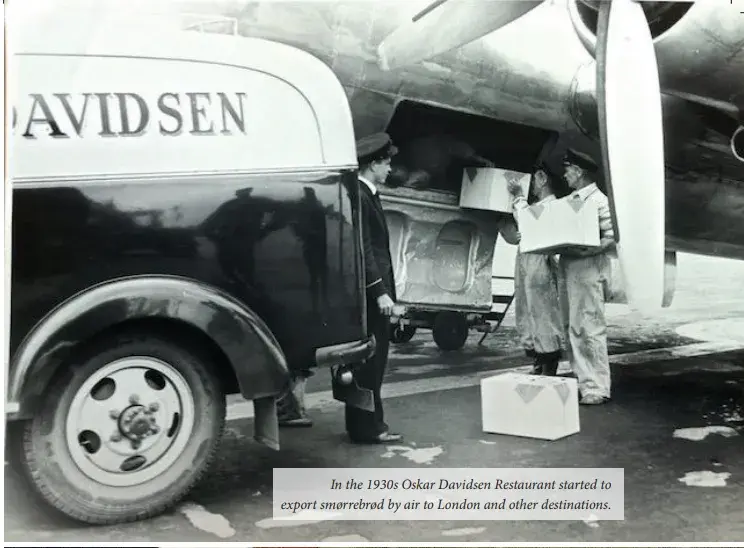
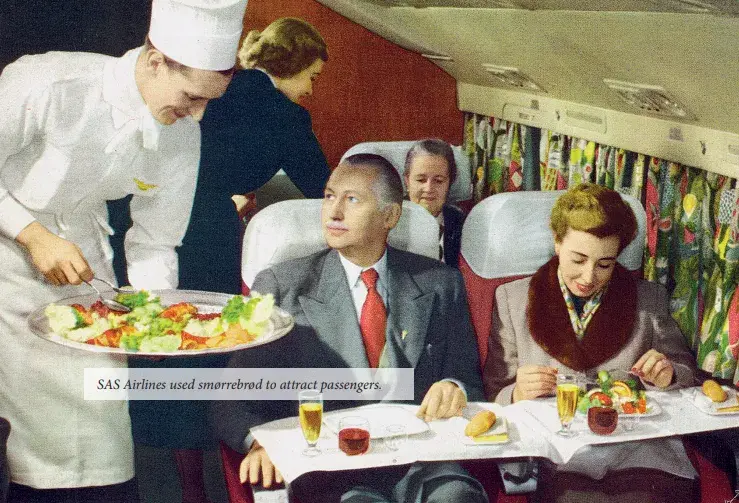
While some suppliers delivered their smørrebrød with a horse-drawn carriage, Oskar Davidsen trumped them by using motorcars and, in the 1930s airplanes to fly smørrebrød to international customers. As flying gained momentum, the smørrebrød followed along. For Scandinavian Airlines System (SAS), it became a kind of secret weapon in its competition with US airlines.
SAS invented the concept of economy class in 1952, and its smaller airplane seats and less luxurious service generated a level of success that American airlines had difficulty matching. In 1958, economy class became a new official price range, carefully standardized by the International Air Transport Association (IATA) with included rules on how much to charge for economy-class passengers. It was agreed that it would be acceptable to serve smørrebrød – or, to be precise, ‘sandwiches’ – as the economy-class meal as long as these meals were ‘simple, cold and not too expensive’. US airlines met these criteria.
But SAS chose to interpret the smørrebrød concept differently, and on the Scandinavian economy class, passengers were given 16 different kinds of smørrebrød to choose from. The US airlines protested, arguing that SAS thereby gained a competitive advantage. SAS responded by running advertisements proclaiming that ‘on our flights there is no indigestible rubber food wrapped in cellophane’. The ads showed photos of delicious smørrebrød that contrasted with US competitors’ cellophane-wrapped sandwiches.
The case resulted in the decision by IATA to impose a $20,000 fine on SAS, but the company was allowed to continue serving smørrebrød as long as the garnish did not cover the entire bread slice, leaving at least 2.5 square inches of bread visible.
If you flew to Los Angeles, you could continue the smørrebrød experience at the Scandinavian restaurant Scandia which was one of the city’s most popular places in the 1950s. Here, young Ida Davidsen was responsible for the smørrebrød. Back in Ida Davidsen’s home of Copenhagen, the old traditional inns serving smørrebrød were soon to come under pressure. Most were housed in the city’s old neighbourhoods where the sanitary conditions were poor, and this led to the demolition of many of the oldest houses in the 1960s. In some
cases, the old smørrebrød restaurants were granted an exemption and could continue until the owner retired. In the longer term, this still put an end to many places.
Poet Sigfred Pedersen, a regular guest at Husmann’s Vinstue, was among the voices that warned against the development. In the 1960s, Pedersen wrote that ‘these inns are precisely the best haven for people with upset nerves, for people fleeing the harsh realities of life,’ and ‘when they are closed down, a double-capacity psychiatric hospital will need to be built instead and paid for by the public.’
The decade brought even more changes. With the youth rebellion and the hippie movement, marijuana, wine, and exotic food became popular, while old-fashioned beer, aquavit, and smørrebrød gradually began to be perceived as outdated. During these years, more and more people started to take an interest in gastronomy, there was a focus on French cuisine, and smørrebrød seemed passé.
A third change was the industrialisation of food production, which meant that the supply of ready-made products grew significantly. Many restaurants stopped making their own products like sausages and mayonnaise since it was cheaper and easier to buy them ready-made. This trend meant that the quality of the smørrebrød was beginning to decline.
Customers also began to drift away in favour of hippie-style vegetarian food or fine French cuisine. The number of smørrebrød restaurants dropped, and these restaurants gradually disappeared from many provincial cities.
In 1971, Denmark’s first gastronomic magazine, Mad & Gæster (Food and guests), warned that the country was in danger of losing part of its culture in its quest for new foreign
restaurants. Jens G. Eilertsen, one of the most influential gastronomic voices of the time, described a visit to an Italian restaurant in Copenhagen:
‘The mood is emphasized by the waiters unnecessarily shouting the orders to one another, singing as just for his own pleasure, placing the minestrone in front of the wondering guest.’ Eilertsen argued that we should value the old Danish traditions instead:
‘Only one place has a local distinctiveness: the smørrebrød restaurant. It is Danish and characteristic of Denmark like the bistro to France, the pub to England and the trattoria to
Italy. It’s something we have for ourselves, the sand on the white wood floors, the oil-painted walls with Erik Henningsen’s sweating Tuborg man in a in a tobacco-blackened reproduction, rather than a fake Italian restaurant with chianti bottles hanging from the ceiling.’
In Copenhagen, however, there were still some bastions of old traditions left, with Oskar Davidsen Restaurant as the strongest. At this time, though, it also struggled, and the large
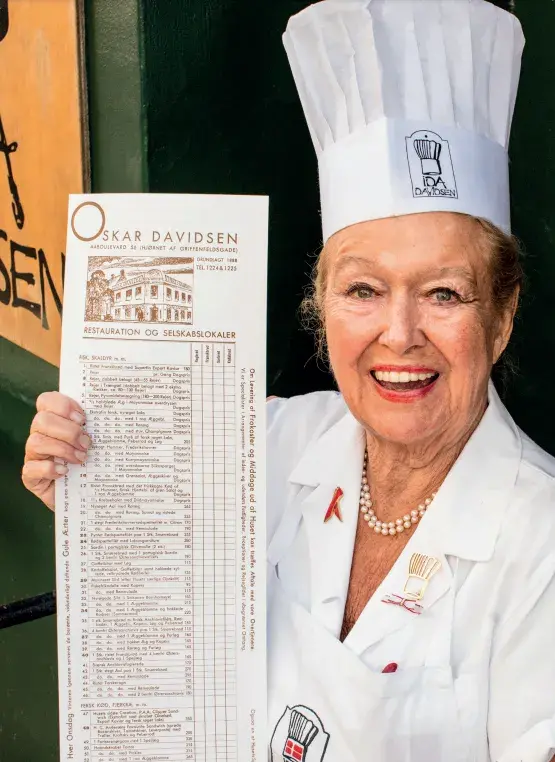
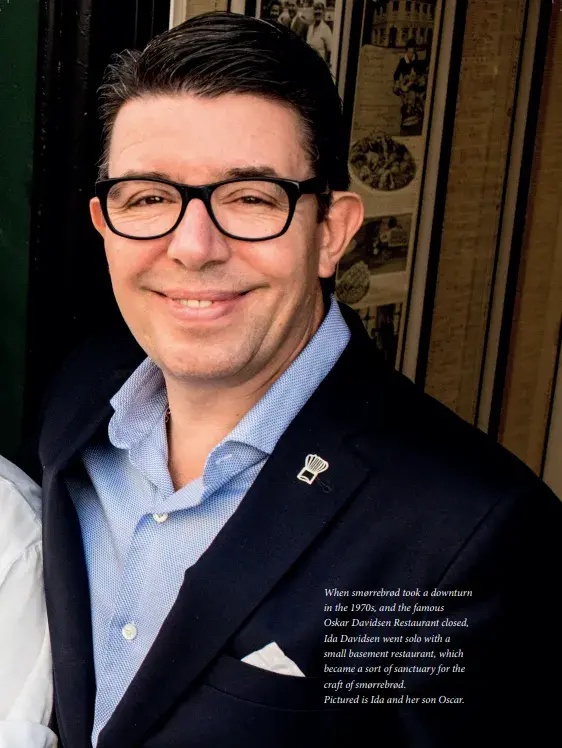
restaurant with several hundred seats had to close in 1974. Ida Davidsen continued the family tradition in a new and much smaller restaurant in a basement on Store Kongensgade.
She was synonymous with smørrebrød at that time, and in the decades when the dish was losing more and more ground, Ida Davidsen kept it alive. She was Danish smørrebrød’s foremost ambassador, and she renewed the speciality with great creativity and maintained a level of quality that was significantly above average.
When foreign media conducted interviews about Danish gastronomy, it was usually Ida Davidsen with whom they spoke. Her establishment was one of the country’s most important restaurant attractions. But her contributions aside, the 1970s was a bleak decade for Danish smørrebrød culture, and it was no longer a culinary experience to eat smørrebrød at a Copenhagen pub or lunch restaurant.
This was partly because industrialisation had eradicated many of the small craft companies that had previously supplied specialties to the restaurants. At the same time, guests were generally not discerning gourmands; in those years, Danes were more commonly concerned with low prices.
Such a climate does not create a breeding ground for quality, so for a long period of time, smørrebrød quality was low. In 1991, the aforementioned food writer Jens G Eilertsen noted that the smørrebrød situation was grave:
‘It is nowadays rarely a culinary pleasure to eat smørrebrød at a Danish restaurant, where the respect for Danish raw materials is absent. Well, the pork roast is usually reasonably
fresh, and the shrimp salad is taken from a can that is far from its expiry date. But the bread! The Danish rye bread, which once was a national pride baked in stone ovens and
proudly served, is today a sad industrial product that is mixed like cement and often tastes like this. After baking, it is frozen, with all the flavours killed off, so it is easier to cut.’
But early in the new millennium, something started to happen. After the French regime of the 1970s and 1980s, the fusion kitchen of the 1990s, and the molecular gastronomy of the 2000s, the concept of traditional ‘grandmother’s food’ emerged. Old Danish dishes – and old French recipes like sauce béarnaise – became popular in certain circles. And what was more natural than inviting the smørrebrød back into the game?
If in the 1980s Danes learned to frequent cafés like Parisians and drink espresso, now they were attracted to the smørrebrød restaurants that their parents had loved but they themselves had previously turned up their noses at.
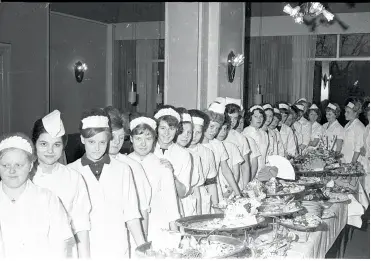
Smørrebrød was a simple and common food up until the late 1800s, so there was no formal education in it before 1934. In 1962 the first school for ‘smørrebrødsjomfruer’ (female
chefs specialising in smørrebrød) was established. By 1973, four schools offered the two year long program, and graduated a total of 700 Smørrebrødsjomfruer.
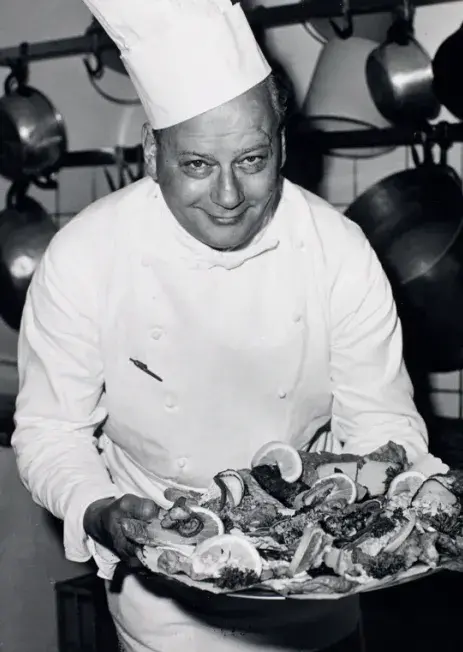
In the 1970s smørrebrød’s popularity waned, and traditional chefs started to replace the specially-trained smørrebrød chefs. This shift was reflected in a new style, where form and size mattered more than substance
Their parents’ beer and aquavit began to appeal to the young. Slowly, the average age among the guests of smørrebrød restaurants dropped. And while in the 1970s through 1990s, mostly older people were found in these places, it became more and more common to see guests in their twenties and thirties.
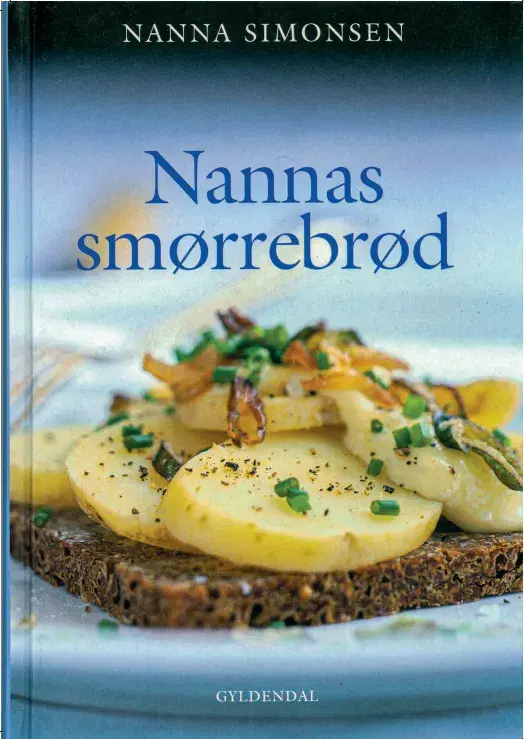
In 2000s a new style of modern smørrebrød started to appear, and it was best described by food writer and chef Nanna Simonsen in her 2001 book, Nannas Smørrebrød. In it, she advocates for a new type of smørrebrød that breaks with the style that had dominated from the 1970-90s, and that may have been one of the reasons for the dish’s decline in popularity.
The traditional chefs, who took over many of the smørrebrød chef positions tended to overdo things, which resulted in smørrebrød with enormous amounts of garnishing. Furthermore, the quality of the produce they used was often not high because of the demand for low prices. Nanna Simonsen criticised this development in which the form of smørrebrød seemed more important than the substance.
‘If the bread and toppings are not of the highest quality, the phenomenon of smørrebrød belongs to gastronomic atrocities, and not to the authentic smørrebrød, which is Denmark’s only and most important contribution to the world gastronomy,’ she wrote in 2001. Coincidentally, this was two years before Noma Restaurant would begin its voyage to worldwide fame and recognition, adding New Nordic Cuisine to the world’s culinary heritage.
The smørrebrød recipes in Simonsen’s book led the way for a more modern take on smørrebrød: one where the garnishing was almost completely stripped, leaving only the main ingredients. In her recipe for a piece with smoked salmon and potatoes, for example, she stressed the importance of cooking the potatoes al dente, and the style she presents is very close to the modern style that would start to win influence in the late 2000s.
One of the first, if not the very first, new places that seemed to follow Simonsen’s suggestions was the restaurant Told & Snaps. It opened in 2000 with smørrebrød chef Helle Vogt in charge of the kitchen, and she later left to revive the historic Tivoli Hallen restaurant, which then also joined the elite. Another remarkable change was, that a gourmet restaurant, Leonore Christine in Nyhavn, put smørrebrød on the lunch menu, by the way with Karina Pedersen – later a star at Schønnemann, Palægade and Møntergade – in charge.
The first steps towards a modern style came in 2001, when cookbook author Nanna Simonsen argued for more simplicity and better quality.
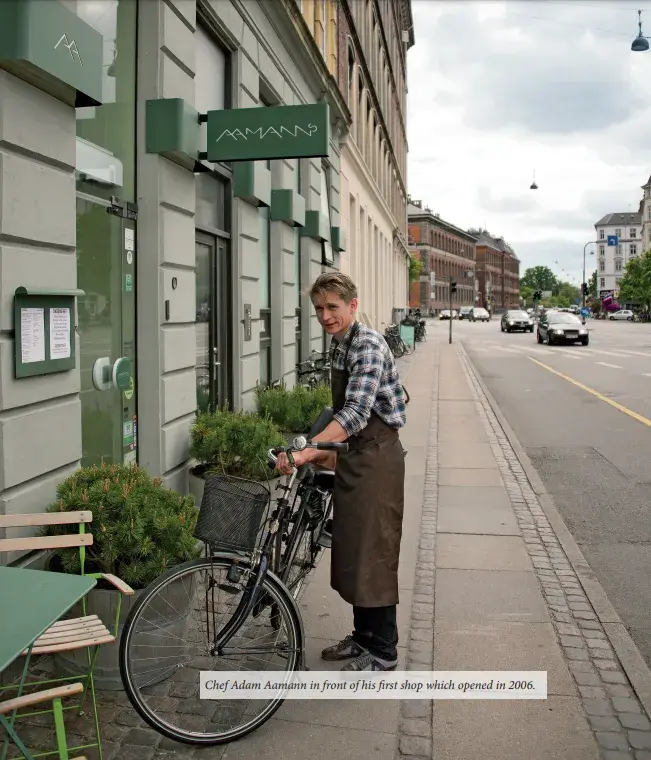
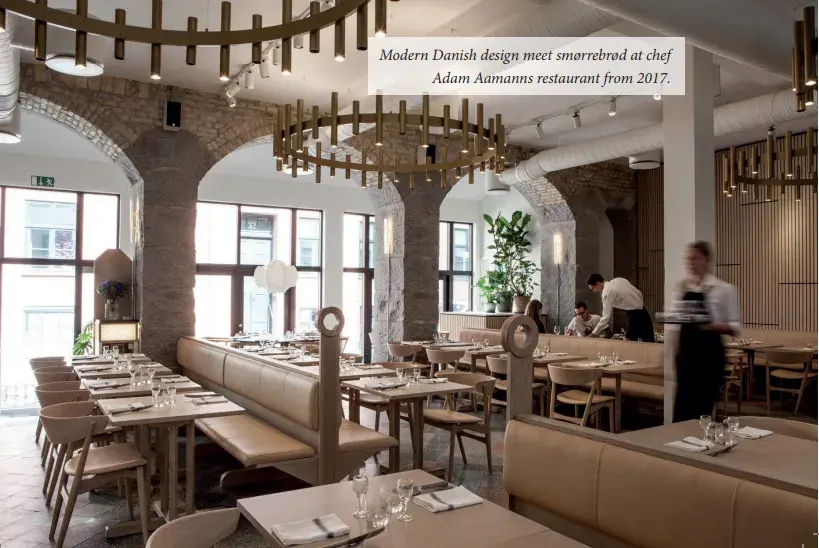
The most influential innovation came in 2006, when young chef Adam Aamann opened the doors to a smørrebrød shop with seating in Copenhagen’s Østerbro neighbourhood. Here you could find smørrebrød of a whole new calibre that was based predominantly on organic ingredients and executed in a tight, unadorned style emphasizing high quality.
So far, it had not been common – or smart – for young ambitious chefs to settle on smørrebrød. It was Adam Aamann who made it legitimate for chefs to move into the smørrebrød category.
In 2007, another important event occurred: a change of ownership at the restaurant Schønnemann, which had not hitherto been known for anything out of the ordinary. This was changed by the new owners John and Søren Puggaard who, by switching over to top quality ingredients, raised the bar for how delicious a piece of smørrebrød can be.
Smørrebrød came back into fashion and played a growing role as Danes started to eat out more than before. Its new popularity made it possible to gradually divide the smørrebrød category into subcategories of classics and modernists. In the following years, encouraged by the growing interest in gastronomy overall, development took off, and Copenhagen gained a number of ambitious new smørrebrød restaurants.
When Noma began to attract many gastronomic tourists to Copenhagen, restaurants like Aamann, Schønnemann, and Skt. Annæ also got a lot of attention in the international press. Gradually, a pattern began to emerge: tourists would come to Copenhagen to eat at the top gourmet restaurants Noma and Geranium, and while they were at it, they would end up trying a couple of smørrebrød restaurants too.
Some years later, the provinces were also blessed with new smørrebrød restaurants of gourmet quality, and today, gourmet smørrebrød in most parts of the country. As a culinary speciality, smørrebrød has never been stronger.
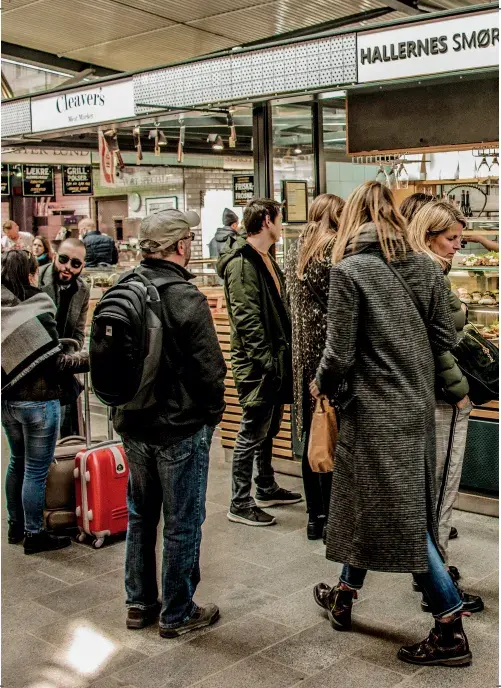
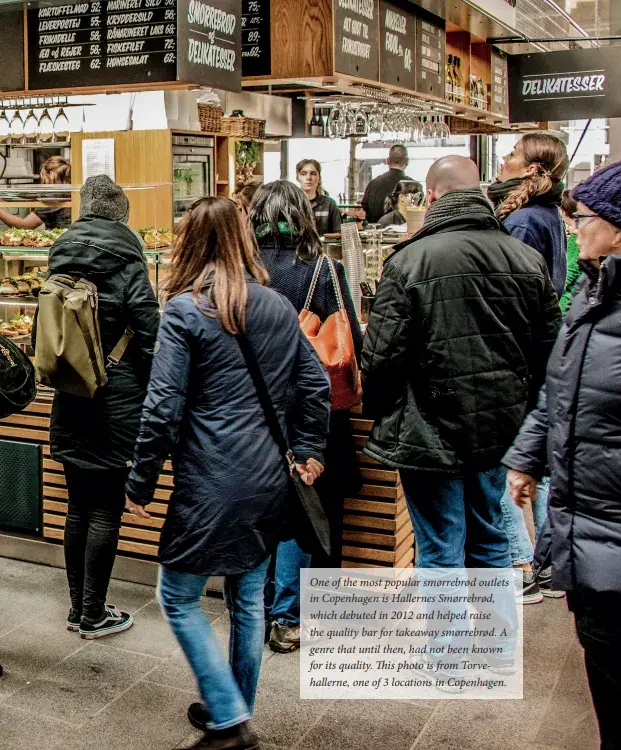
In 2001 my relation to smørrebrød turned professional when I was appointed full time restaurant critic at the Danish newspaper Børsen. The job placed me in a good position to report on this culinary niche, and write several books on the subject. Let me start this one by trying to give an overview of the present state of smørrebrød, and by trying to answer a question I get asked regularly: what is the best smørrebrød restaurant in Denmark?
Thirty years ago, I would have answered that it was Café Sorgenfri, but this restaurant is very low on my list today. Twenty years ago, the answer might have been Slotskælderen hos Gitte Kik, as this was one of the first among the old guard of restaurants to have a high-gastronomy boost.
Ten years ago, the question became more difficult to answer, since there were two very strong contenders: Aamanns Etablissement and Schønnemann Restaurant, two of the most important forces in leading the way forward in the smørrebrød genre. Since then, new advances have been constant. Every year has brought new restaurants that deservedly claim smørrebrød fame, so let’s have a look at the most important ones.
If I were forced to name only one restaurant as my favourite, it would be Schønnemann, since scores a maximum six stars in every one of the six categories I evaluate: Most important is, of course, the quality of the food. Then comes the drinks, service, comfort, and hygge – the Danish description of cosiness – and lastly, but also importantly, the variety on the menu. A handful of very good smørrebrød dishes makes for a good smørrebrød restaurant, but it takes much more to be one of the best.
A large variety with dozens and dozens of different kinds of smørrebrød was an important factor in the early history of this culinary speciality. Throughout history, the Oskar Davidsen Restaurant was world-famous for offering 178 different combinations of ingredients, and this tradition of variety became a marker of seriousness for smørrebrød restaurants.
However, as trends in haute cuisine shifted in the 1990s and 2000s and went from elaborate lists of choices to relatively simple set menus with five or six courses, this also influenced smørrebrød.
A proponent for this simplification of the smørrebrød menu was chef Adam Aamann. He was the first chef from outside the genre to enter it and become successful by promoting a more modern style, where quality was more important than appearance. This happened back in 2006 when he opened a small deli that became known as one of the very best smørrebrød places, even though it only offered a fraction of the varieties that were expected of a good smørrebrød restaurant.
Aamann’s argument was that most of the old smørrebrød restaurants served an inferior product. I would agree: you are much better off with a restaurant offering a total of ten different good-quality choices than with one offering 100 different low-quality pieces.
While I welcome this development, I also have my reservations. For me, one of the joys of smørrebrød is that it is democratic. The dish makes it possible for a group of very diverse people to eat happily together because you can easily put together a meal catering to most tastes, religions, beliefs, and strange whims.
This is easy with a classic large assortment, but if the assortment is cut down to only five or six different pieces, as is seen in some of the otherwise good restaurants, it becomes harder. And, apart from this, I simply love the feeling of being a small child in a candy store with permission to grab whatever I want. This is why this book, for the first time, includes variety as a determining factor in the overall evaluation of the restaurants. I am ready to meet the criticism that variety is not so important. But I disagree, and in an attempt to console my critics on this point, let me underline that variety is only one of the six total assessment points, whereas taste, drinks, (etc.) make up the other five criteria.
Back to Schønnemann. This restaurant was the first of the old classic establishments to adopt a new set of ambitions when, in 2007, the new owners decided to try and mirror the gastronomic revolution taking place among Danish gourmet restaurants. And even though the restaurant was sold back in 2016, the new owner has managed to stay the course. The quality of the food may have suffered slightly when head chef Karina Pedersen left Schønnemann to open her own
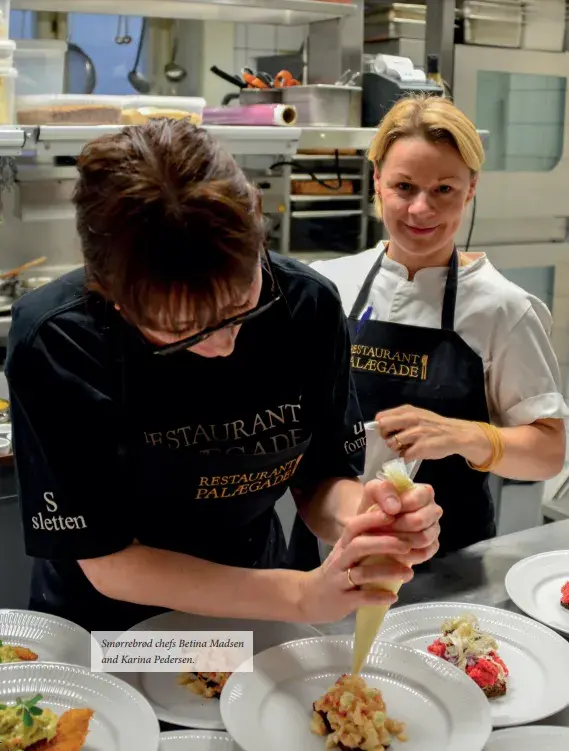
place, Palægade Restaurant. But if Schønnemann used to be at 24 carat with Pedersen at the helm, it remained at 23,5 carat.
Palægade Restaurant was an instant success, and among people in the know, it became regarded as one of the country’s finest establishments. Sadly, the place burned down in early 2020, leading Pedersen and her partners to leave and open a new place, Møntergade Restaurant. Run by the same people as Palægade, Møntergade was also a guaranteed success, and it too is on my list of the best.
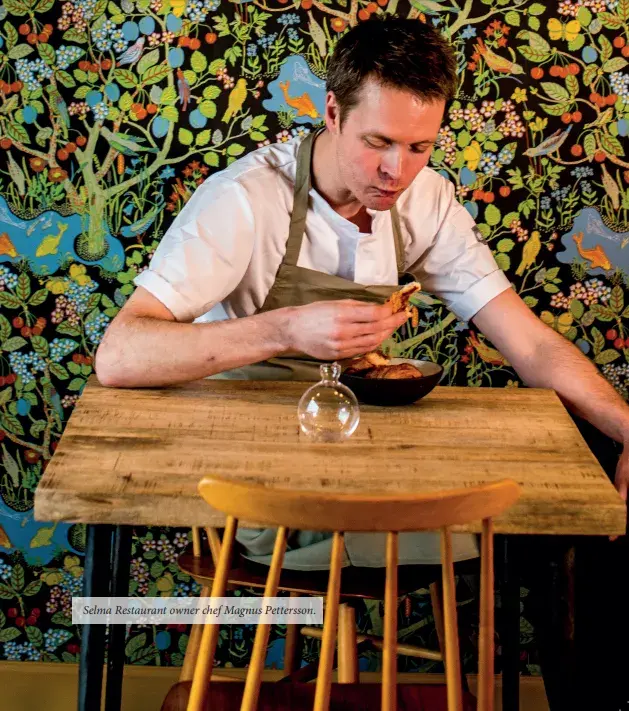
Ask me what the best smørrebrød restaurant is when it comes to creativity, and I will, without hesitation, say the Copenhagen restaurant Selma. This modern take on the genre is run by chef Magnus Pettersson, who used to be head chef for Adam Aamann and has clearly been inspired by him.
But at Selma, chef Magnus Pettersson takes smørrebrød one step further, experimenting while still keeping an eye on the classic heritage. The beer selection is the best in the business, and the atmosphere in this avant-garde smørrebrød restaurant is charming.
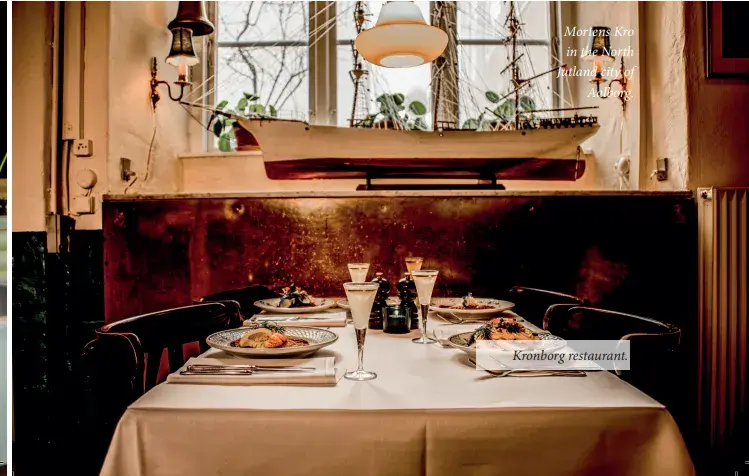
In the next tier are places like Kronborg Restaurant, another old classic which was revived by new and ambitious owners who manage to balance the old classics with a slight touch of modern gastronomy. The hygge factor is high at Kronborg. The restaurant is privileged with its spot in one of the most charming quarters of Copenhagen.
At the same quality level is Told & Snaps restaurant. This establishment was a real frontrunner when it was opened as a new, ambitious smørrebrød restaurant in the year 2000. It was well ahead of the developments soon to come.
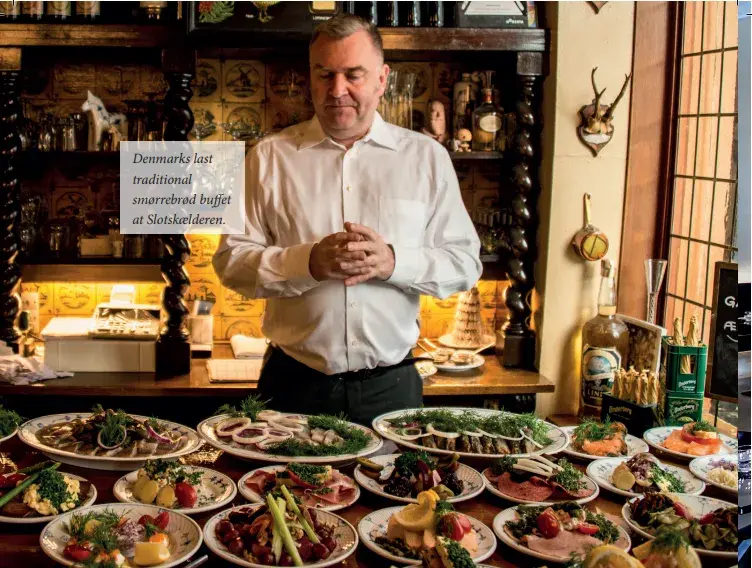
A relative newcomer among the classics is Lumskebugten restaurant, run by one of Denmarks most important gastronomic icons, Mr. Erwin Lauterbach. If you ask me which restaurant gives you the most authentic experience, Slotskælderen is the champion. This is one of Denmark’s oldest and most conservative smørrebrød restaurants, meaning that the interior looks almost like it did 100 years ago. Slotskælderen is the last to offer the traditional buffet where you can choose between the various pieces. And even though the quality does not live up to the level of the aforementioned top restaurants, it is so tasty that I eat there several times a year, although my visits there are more motivated by the atmosphere than by the food.
I could go on and on describing the ever-growing number of good places, but you can find my simpler recommendations for the others on pages 204-234.
Please be aware that the quality of smørrebrød varies enormously. Don’t be fooled by the many restaurants that put signs out in the street promising ‘traditional smørrebrød.’ The majority of those restaurants are not worth visiting, but if you stick to my list, I am sure you will not be disappointed. And if you are, or if you discover a new restaurant you’d recommend, then please write to me at ole@troelso.com. I would be glad to hear from you.
Danish smørrebrød gained international recognition in the early 1900s and again in the 1950s, but the present fame is unsurpassed, and enthusiasts all over the world have adopted the Danish speciality
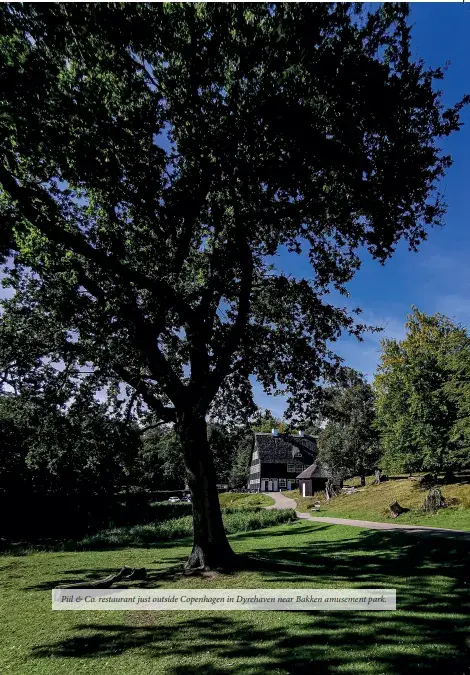
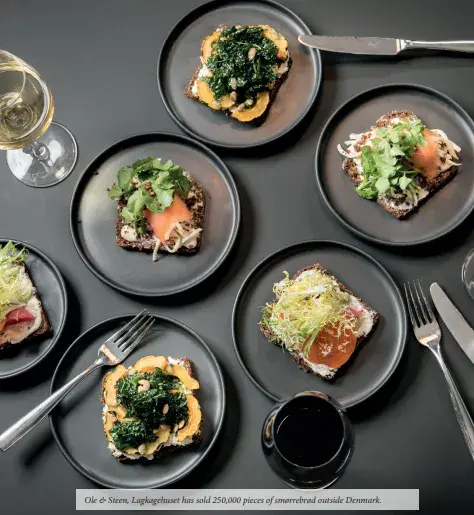
In Danish newspapers from the early 1900s, it is routinely mentioned that the Danish smørrebrød has become world-famous, and by the 1930s, Copenhagen restaurant Oskar Davidsen had established export by air transport. Smørrebrød became popular with several airlines, and the earlier procedure of packing the smørrebrød with ice for long-distance flights was replaced by local production at airport hubs around the world.
Also in the 1950s, Ida Davidsen was hired to introduce smørrebrød at the highly popular restaurant Scandia in Los Angeles owned by Dane Kenneth Hansen. For a period of around 10 years, smørrebrød enjoyed fame at this restaurant as well as in the city of Solvang, also in California. But apart from the odd Danish-themed restaurant here and there in the world, smørrebrød did not catch on as a trend like the New Nordic Cuisine did in the 2010s. It was probably due to the enormous interest in the New Nordic Cuisine that smørrebrød managed to piggyback on, but it looks like smørrebrød has now made a real international breakthrough.
Danish smørrebrød star Adam Aamann tried his luck with a smørrebrød restaurant in New York in 2012, but it did not catch on and existed there for only a few years. In 2016, Noma co-founder Claus Meyer introduced smørrebrød at his new food market, Great Northern Food Hall in New York. Here, it was a bigger success than the Aamann project, and it was operating successfully for several years. However Claus Meyer left the company in 2020, and as these words are written, due to the corona crisis, the Great Northern Food Hall is closed.
The most successful purveyor of smørrebrød outside of Denmark is Danish bakery chain Ole & Steen, Lagkagehuset. To date, the chain has sold more than 250,000 pieces of smørrebrød in its London and New York outlets.
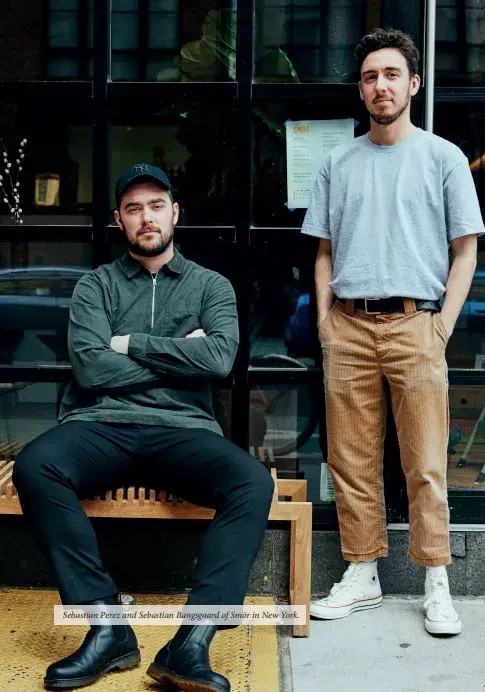
Also in New York, the two Danish entrepreneurs Sebastian Perez and Sebastian Bangsgaard have been successful with smørrebrød at their Café Smör which opened in 2019. Both previously worked for the now defunct Aamanns-Copenhagen restaurant.
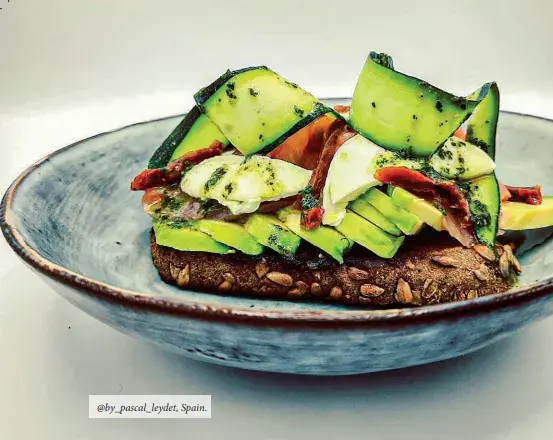
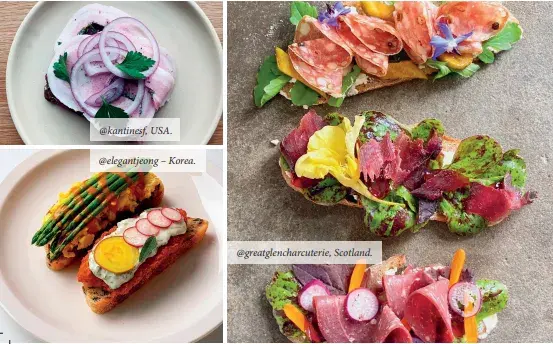
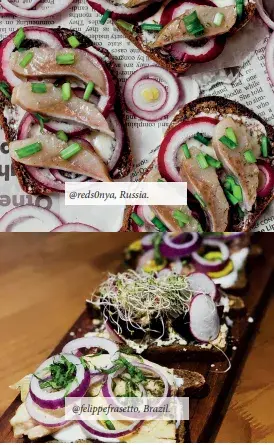
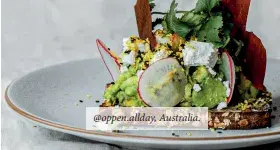
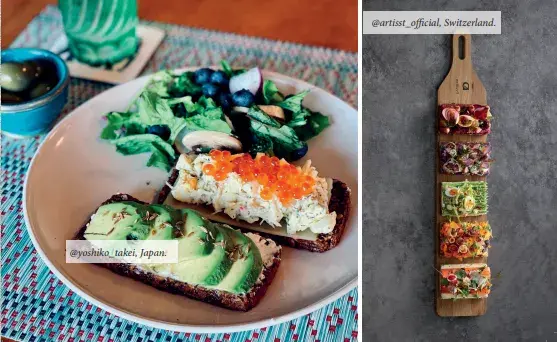
These pictures are some of the signs, that smørrebrød is increasingly being made outside of Denmark. They show smørrebrød made in Korea, Japan, Spain, Russia, Turkey, Switzerland, USA and Brazil. They were downloaded from Instagram, where at time of press, the hashtag smørrebrød is attached to almost 100.000 pictures, and the #smorrebrod has reached close to 30.000.
On the opposite coast, in San Francisco, smørrebrød is available at Kantine, owned by chef Nichole Accettola. She is American, but lived for ten years in Copenhagen, where she learned the craft of making smørrebrød.
In the UK, smørrebrød has become popular lately in London. The city has several recently opened smørrebrød outlets, namely ScandiKitchen, Ekte Nordic Kitchen, The Bread Station, Nordic Bakery, bakery chain Ole & Steen, Lagkagehuset and Aquavit.
The German city of Hanover has also been blessed with a smørrebrød outlet after a Dane named Rasmus Christoffersen left the furniture business and started making ‘smörrebröd für alle!’ in Markthalle Hanover at Aelling.
In the French city of Strasbourg, authentic smørrebrød can be found at the café Nørrebro, which was founded by Danes, just as there are Danes involved in the aforementioned London places.
But in Switzerland, two Swiss citizens have made smørrebrød their main focus. They are chefs Quentin Lachat and John Revilla. They adopted the concept of smørrebrød as their speciality after visiting Denmark in 2018. They fell in love with the idea of smørrebrød and have since interpreted it with local Swiss produce. Every day, they cruise the Bern area with their food truck, supplying smørrebrød to office workers, just as they cater for various events. A clear sign that the smørrebrød love is spreading around the world is the Instagram hashtag #smørrebrød, which at the time of publication is close to 100,000 pictures, while #smorrebrod is close to 30,000.
While a few posts show a misunderstanding of the concept, the majority are true to the soul of Danish smørrebrød. Sometimes it is clear that the pieces have been altered to fit a local culture or taste, which is interesting and inspiring to see.
Looking through those 130,000 pictures makes you realise that travel guide Lonely Planet was not mistaken when they, in 2018, named smørrebrød the no. 6 in their ranking of the world’s top 500 food experiences. Smørrebrød in Copenhagen was listed in front of, among others, pizza in Napoli, and this ranking may well be the largest praise smørrebrød has ever garnered.
An important part of a traditional Danish lunch is aquavit: the strong spirit that is to Scandinavians what vodka is to Russians and whisky is to the Scottish and locally called snaps
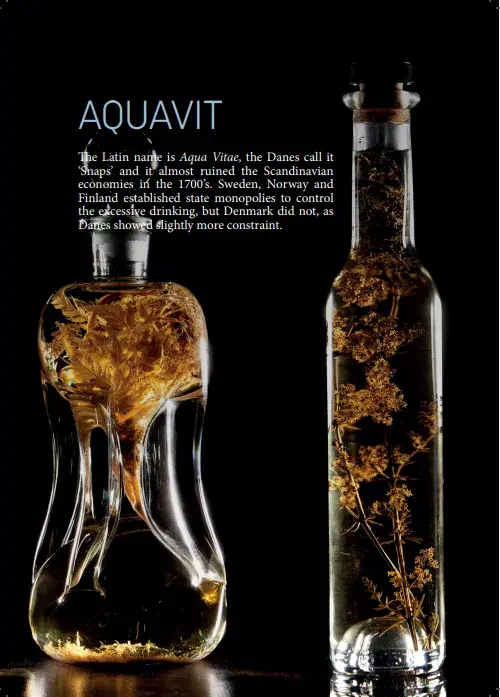
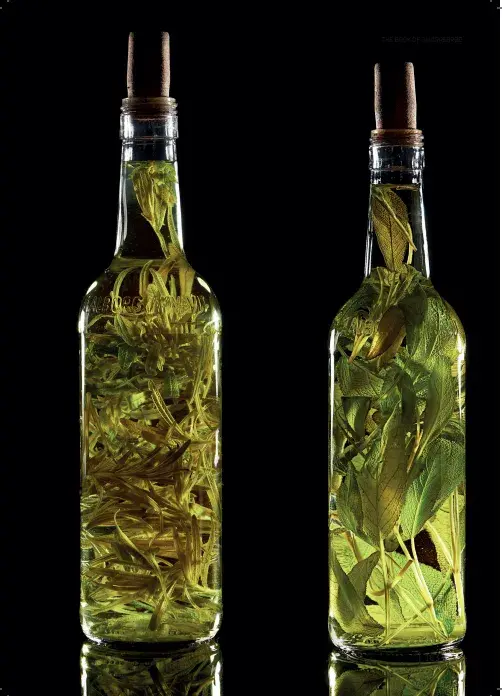
In Denmark the technical definition for aquavit is alcohol made with a destillate made with caraway or dill. Often a variant is made, where the herbs are not distilled but infused, and technically this is not aquavit but snaps.
The original meaning of snaps is ‘a small mouthful’. This gives the term some resemblance to the Russian vodka, meaning ‘little water’. The Swedish call aquavit brännvin, the Norwegians brennevin, and the Icelanders brennivin. This points back to brandy, which originates from when the Dutch merchants distilled wine – i.e. ‘burned’ it – to concentrate the alcohol, making it easier to distribute. This, incidentally, inspired the French to invent cognac, but that is a different story.
In this book you will find use of both the words aquavit and snaps, just as the Danes in general does not discriminate between aquavit and snaps. If you ask for either at a restaurant, you will probably be offered the same; a strong alcohol with some kind of herb flavour. The most common spice has historically been caraway, so for hundreds of years, the taste of aquavit was generally also the taste of caraway. But alongside the caraway aquavit, there is also an old tradition for homemade variants where neutral spirit is infused with a long list of herbs.
Within the last 10 to 30 years, however, the taste of aquavit has evolved with more possibilities, and only now has it entered the gourmet era. This is thanks to the craftsmen at the distilleries who know how to combine many types of spices, berries, fruits, nuts, leaves and flowers to help make the different aquavit flavours akin to fine eau de vie like whisky and cognac.
Aquavit was introduced in Scandinavia around 1400, and the earliest source in the Danish language referring to it is a book from 1555 written by a medical doctor. Around that time, aquavit – from aqua vitae, Latin for the ‘water of life’ – was considered a medicine used to treat many diseases. During the 1600s, the popularity of aquavit grew and grew, as did the consumption of it in all of Scandinavia.
In Denmark, one in every five families possessed their own spirit still for making alcohol but the collective understanding of the chemical processes involved was very limited, resulting in spirits with many faults and foul-tasting, poisonous substances like fusel oil. This was probably the reason for adding spices to the aquavit, rather than consumer demand for the taste of the dominating spice, caraway.
Given time, aquavit started to pose an enormous problem: it became a serious threat to the country’s economy, as the workforce was often not able to work due to drunkenness. Furthermore, the side effects of drinking aquavit gravely impaired the health of the population. This led to a ban on home distillation in the 1600s. From then on, permission from the king was necessary if you wanted to distill spirits. This permission was given to a number of inns around the country, who in turn paid tax. Later on, the rules were tightened further, and in the1800s, a school for distillers was established. It became obligatory to take a course before being allowed to open a distillery.
Around that time, the Crown strengthened its grip on illegal distilleries and offered them a deal. If they voluntarily gave up their copper stills, they would not be punished, and on top of that, would be paid for the value of the copper. This yielded no fewer than 11,000 copper stills, and given that the population was around 2 million, added up to one still per 181 Danes.
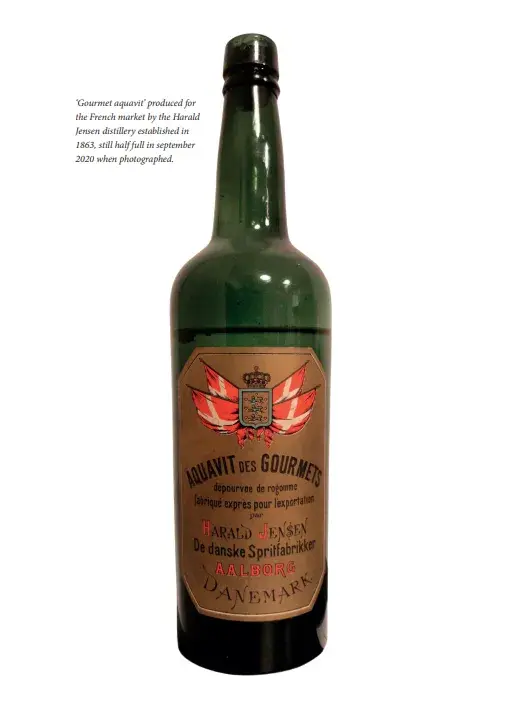
After this purge, Denmark had 800 official distilleries: a number that dwindled when, in 1881, a new conglomerate started to monopolize spirit production. This was Danish Distillers – De Danske Spritfabrikker – whose driving force was the former distiller Isidor Henius.
Henius introduced a new technique that created the first spirit free from the poisonous fusel oils. Henius became the most important person in Denmark’s spirits industry, and his efforts to consolidate the distilleries achieved success in 1923. In that year, Danish Distillers became the sole producer of spirits in Denmark, and started to build a reputation and garner high acclaim for Danish aquavit in international markets.
It is a popular belief, even among Danes, that Danish aquavit is made from potatoes. This belief is not altogether correct. Even though potatoes started to play a small role in alcohol production during the 1700s, grains were the most common base for aquavit. But in the 1800s, potatoes became increasingly popular, and in 1838, the first dedicated potato-based distillery in Denmark was built. This was the birthplace for what would become the country’s most popular aquavit: Aalborg Taffel. However, potatoes stopped being used as the base for spirit in 1990, because they were too expensive.
Economics was also a factor in making aquavit the most important component of Danish drinking habits for hundreds of years, since imported spirits were heavily taxed. Taxation made imported spirits like whisky and gin cost two to four times the price of Danish aquavit.
But when Denmark joined the European Common Market in 1973, the tax laws changed, making imported spirits more affordable and making it easier for foreign spirits companies to begin aquavit production in Denmark. This was not attractive, however, as Danes were beginning to lose their thirst for aquavit for the first time in hundreds of years. Aquavit began to fall out of fashion in the 1980s with the younger generations regarding it as a drink for old people. The market shrank gradually as older consumers passed away and were no longer replaced by younger ones.
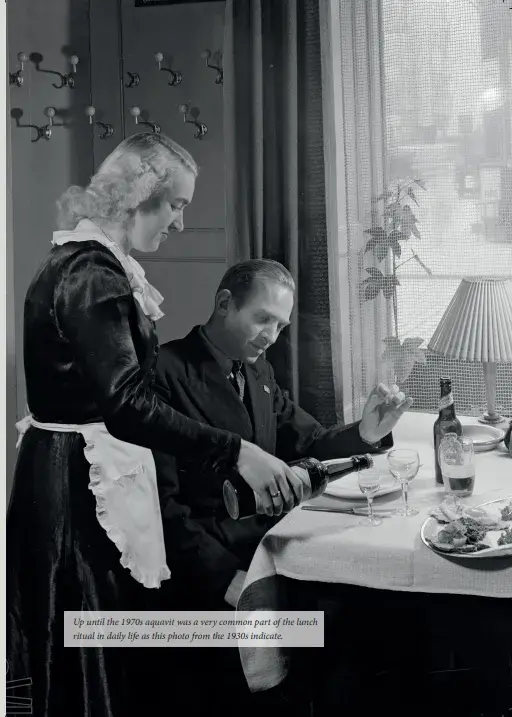
However, the market remained lucrative. Even though the Danes had stopped drinking aquavit daily with breakfast, lunch, and dinner like they commonly did from the 1700s up to the early 1900s, it remained popular with traditional Danish festive lunches. Furthermore, though aquavit became unfashionable in the 1980s, it enjoyed a second wind with the smørrebrød renaissance in the 2000s.
Alongside smørrebrød, aquavit slowly gained popularity, and new small producers started to appear and swell the category’s ranks. One of the first movers and shakers in this new wave was Dan Schumacher. He was not an aquavit professional but rather a chef with a strong interest in aquavit. With this interest came his desire to contribute new inspiration to the old aquavit category which had hitherto been dominated by the taste of caraway. Instead of using distillation, he infused a ready-made alcohol with herbs: a technique that had been traditional in many private homes for centuries. In 2001, Schumacher created a chili and lemon snaps which soon caught on, and soon his products were carried by hundreds of Danish restaurants.
The next wave in modern aquavit production came when some of the newly established microdistilleries – mostly founded in the 2000s and 2010s – took a liking to aquavit. The very first to bring back aquavit distillation to Copenhagen, where it had ceased in the early 1900s, was Henrik Brinks. Growing up in the 1970s and 1980s, he was a member of the very generation that abandoned their parents’ drinking traditions by shying away from aquavit.
‘I hated the stuff,’ says Brinks, who defined himself as a ‘whisky man’ during the many years he dreamt of opening a distillery. In 2014, he followed his dream, quit his daytime job as an attorney/consultant, and founded Copenhagen Distillery, which by the way was awarded the title Danish Whisky of the Year 2021 by whisky guru Jim Murray.
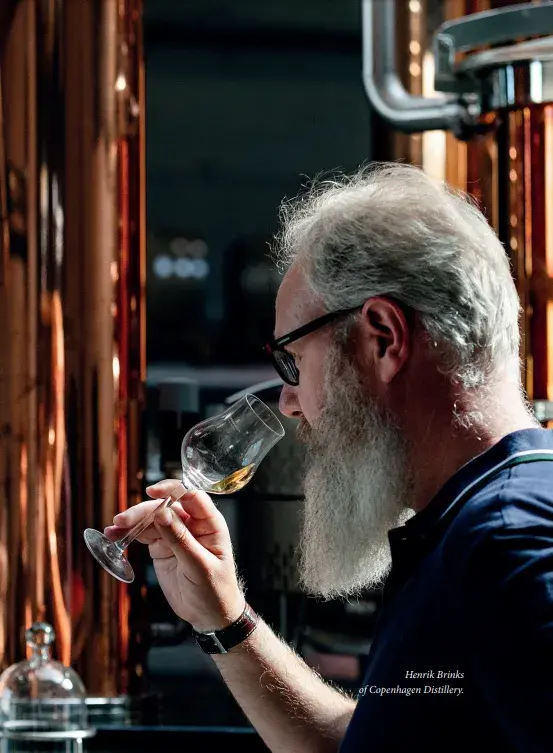
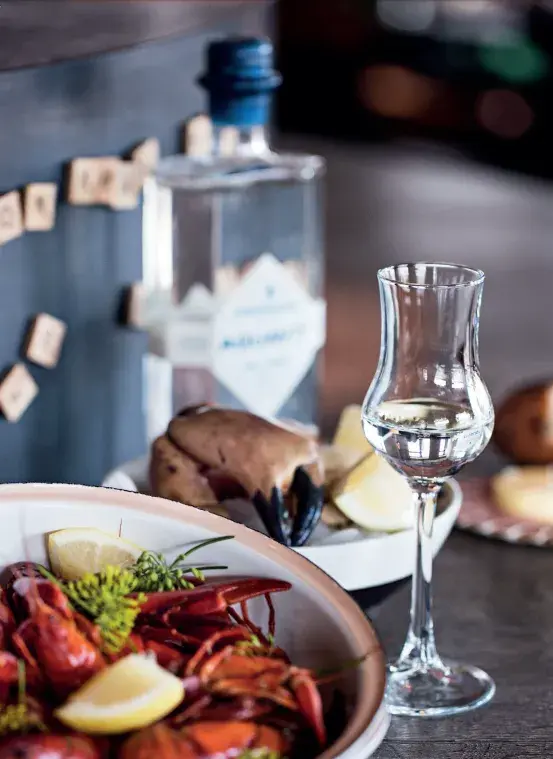
‘Yes, I was one of the many young people who really did not like the taste of caraway, and as imported spirits became cheaper, there was really no reason to drink the Danish aquavit, we figured,’ explains Brinks about his generation’s abandonment of aquavit. But one day he was approached by a young bartender, Sune Urth, who suggested that together, they take a shot at modernising the aquavit genre: ‘At first, I was reluctant, but Sune convinced me that aquavit could have a whole other dimension than the one we knew, so I decided to give it a chance. And soon I realised we were dealing with a hidden gem: a forgotten treasure that is actually the soul of Denmark’s spirit heritage.’
‘We started out with a take on the classic Taffel Aquavit, but instead of potatoes, we brought another old, popular Danish crop in play, the sugar beet, and combined it with grain spirit. The sugar beet gave the spirit a certain tough edge, and the only spice we used was caraway. It was as old school as it gets, but the taste was so different than what I had ever experienced before,’ says Brinks, who enjoys serving aquavit to guests at the distillery.
‘We arrange many tastings. Whisky is the most popular, and often I hear somebody say when they look at the aquavit bottles that they hate the taste of aquavit. The same people sometimes praise the ‘welcome drink’ they are served when arriving, and they are all very surprised when I tell them it is actually aquavit,’ laughs Brinks. Truth be told, it is not a classic caraway-scented aquavit, and Henrik Brinks has also included more modern types of the old spirit like the distillery’s variation infused with mulberry rose and another with cinnamon pepper.
‘Both these variations took off. I was surprised how popular aquavit became with many bartenders who use it in cocktails, and I, the old aquavit hater, now have an aquavit martini as my absolute favourite cocktail,’ says Brinks, who is zealous about restoring the image of Danish aquavit ‘as a spirit that does not bow to whisky, cognac, or any other foreign spirit.’
Copenhagen Distillery is just one of the dozens of new players on the aquavit market. At present, there are more than 20 distilleries producing aquavit along with others that do not actually distil, but use subsuppliers. The combination of fresh new players and historical brands has created a vibrant aquavit scene both in bars and restaurants.
One of the newest additions to the aquavit scene is Snaps Bornholm, which in record time after entering the market has gained a strong foothold. The company hails from the island of Bornholm, known as a gastronomic destination, and Simon Lorentzo, one of the founders, explains that the gastronomic angle was indeed a stepping stone.
‘We were absolute beginners in the aquavit business, amateurs who had been making our own herb- and fruit infused aquavits at home, deciding to give it a commercial try. This led us to

Bornholm, which is known for gastronomy and fine produce, something that the Michelin star restaurant Kadeau made us realize. Also, Bornholm is an island in the blue ocean, and our strategy has been exactly the same,’ he says, referring to the so called Blue ocean strategy, which pursuits differentiation, open up a new market space and create new demand.
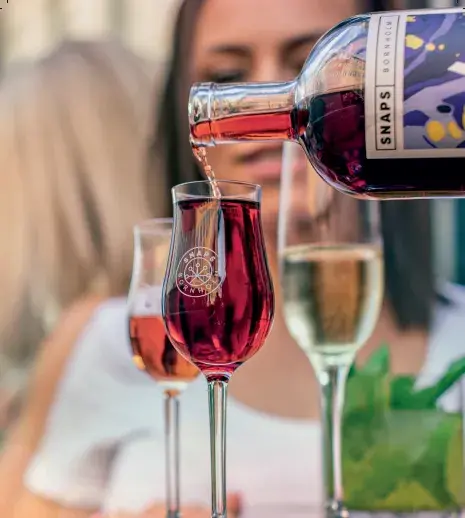
‘Not that the aquavit market is by any means new, but our products are very different from the ones known already and this is very clear visually. Snaps Bornholm bottles looks different from the competition, and the taste is also different,’ says Simon, adding that the decision to only use organic ingredients differentiated the new player from the rest. Also they went to market withunusual tastes like hot chili, a combination of dill-cucumber, seabuckthorn, figs, rasberry-ginger-pomegranate and the ubiquitous Nordic acquired taste; licorice.
‘We wanted to give people an aquavit that they could really enjoy, which is why we chose these taste combinations, and we distributed special tasting glasses as well, to encourage people to treat the aquavit as something to enjoy carefully, rather than just chugging it down, which has been the traditional way to drink aquavit for hundreds of years,’ Simon Lorentzo explains. He does not say ‘cheers’ when he raises the glass but ‘sip!’ to underline that a glass of Bornholm snaps should be enjoyed slowly and in small sips.
‘Traditionally women tend to shy away from Danish aquavit, but with Snaps Bornholm it is different, so we have created a new market. And I think women have helped draw attention to the fact, that this aquavit can actually be enjoyed,’ laughs Simon Lorentzo.
And he is right about the enjoyment of aquavit being something rather new, as opposed to quickly downing shots of ice-cold spirit as is customary. Another proponent for the more connoisseur oriented style is veteran aquavit specialist Lars Kragelund.
Lars Kragelund is also a Food Specialist, and has put in a great effort to make people understand the true nature of aquavit as a companion to food, and he stresses that the pairing of different aquavits with the many different kinds of smørrebrød holds pleasures that can be compared to the pairing of food with fine wines: they complement each other.
And where Danish tradition calls for drinking aquavit as cold as possible and downing it like a shot, modern aquavit culture is more about sipping carefully to give the aquavit a chance to play with the food. For example, pairings might include caraway aquavit with fried herring on rye bread, dill aquavit with smoked salmon on white bread, the sweet-gale aquavit with roast beef, and oak-aged aquavit with beef tartare, or with the coffee instead of cognac.
Lars Kragelund is especially keen on the pairing of aquavit and herring.
‘Nordic raw materials are grown in a cool climate which often means more acidity and less sweetness, especially in our fruits. Our food traditions include classic preservation methods such as salting, pickling, and smoking in the processing of our raw materials,’ says Kragelund before laying out the ground rules for pairing aquavit.
‘The herring is a fatty fish that is processed according to the above principles. Whether served cold or hot, it tastes good with an aquavit because the alcohol helps release the aromas from the fish’s fats: a release that takes place in the mouth as we chew the fish and subsequently sip on the aquavit,’ he explains.
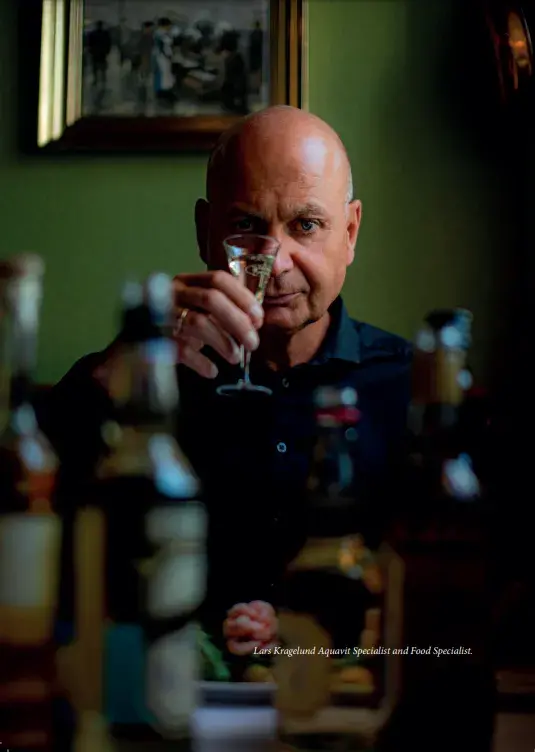

He moves on to discussing why the fat, sour, salty, and smoked tastes of herring go well with aquavit, saying that since ‘aquavit is sweet in its basic nature’, it ‘plays nicely the with sour, salty and smoked, slightly bitter tastes’ of many herring recipes. One pairing example is the classic marinated herring served with a ring of raw onion on rye bread along with a caraway aquavit. The marinade contains vinegar, allspice, anise, fennel, salt, and pepper, and the naturally matured herring has a taste of umami.
‘It is a very complex taste and scent experience,’ says Kragelund. ‘If you drink a caraway aquavit with marinated herring on buttered rye bread garnished with onion, you have a meal that is sensually complete; the basic flavour of the herring is slightly salty-sweet, which plays well with the aquavit’s sweet alcohol. The onion has a sweet after-taste, which goes well with the alcohol’s discreet and refined after-taste of anise and star anise. The spices of the marinade and the caraway of the aquavit play together and against each other – they simply lift each other up to new sensory heights. Last but not least, the grains and vinegar appear as were they created for each other. Individually, they may seem a little daunting to the untrained palate, but together they unleash each other’s beauty. However he suggests some caution for beginners:
‘The first time you try the combination of marinated herring and aquavit can, figuratively speaking, be compared to a strenuous hike in a rainforest with lots of mosquitoes and other bugs. Just when you are about to give up, the miracle happens. You enter a clearing where the trees give way to the sun and clear blue skies. Butterflies dance in the air, and you smell the flowers, all but forgetting your previous trouble. That’s how it feels when you start by taking a bite of the herring smørrebrød and a sip of aquavit. You close your mouth, swallow, and then you experience, perhaps not the first time, maybe not the second, but probably the third time, how the aromas of the herring dish and the aquavit cause the sensory forest clearing in your mouth. Once you have experienced this, you will never forget it.’
As an addition to Lars Kragelunds explanations, here are som some rules of thumbs worth remembering, when you drink aquavit. Number one is sip, don’t gulp. When you sip instead of gulping it down, you significantly enhance the experience. This is because your saliva contains water which enhances the aromas, it can be compared to adding a few drops of water to a glass of whisky. In addition, the temperature in the mouth is approximately 32 degrees celsius. This relatively high temperature helps to release aromas from the aquavit, as aromas are slightly volatile. If, on the other hand, you swallow the aquavit in one mouthful, then the amount of alcohol acts as a solvent and the mouth is cleared of the good saliva, leaving the mouth ‘chemically cleansed’ with an unpleasant burning feeling as a result.
The general rule is that clear aquavits should be enjoyed cold, and golden aquavits should be enjoyed at room temperature. Clear aquavits traditionally have a relatively high aroma content that can withstand being cooled without significantly loss of aroma. Golden aquavits traditionally have a lower aroma content, and in addition are often barrel-aged and therefore contain ‘heavier’ and less volatile aroma substances. These aromas must therefore be helped out of the product, and this is achieved with a higher serving temperature.
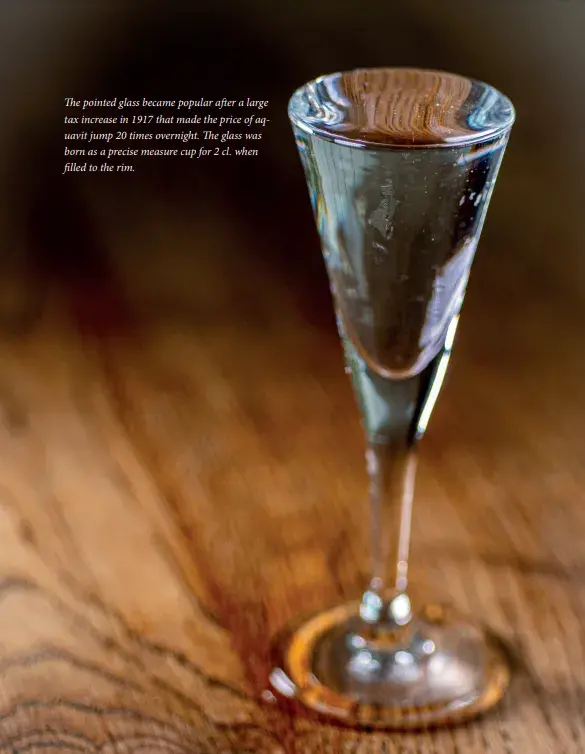
Clear aromatic aquavits should be enjoyed in small pointed glasses, and golden aquavits should be enjoyed in tulip-shaped glasses. With the higher concentration of spices in clear aquavit, this spirit is better suited to being served in the pointed glass. They have a very volatile aroma that, if served in a tulip-shaped glass which collects the aromas, would ‘burn off the nose’ when you sniffed the glass. On the other hand, the shape of the pointed glass lets the strong aroma concentration ‘run over the edge’.
Golden aquavits are born with slightly ‘heavier’ aromas because they have a lower spice concentration, and during storage in the wooden barrel, they form complex aroma molecules that are heavier and less volatile, which require the use of a tulip-shaped glass. The tulip-shaped glass makes it possible to swirl the aquavit, thus giving the liquid a larger surface from which its aromas can be released. In addition, the combination of the turbulence you create in the liquid when you move it plus the oxygen in the air also releases the aromas.
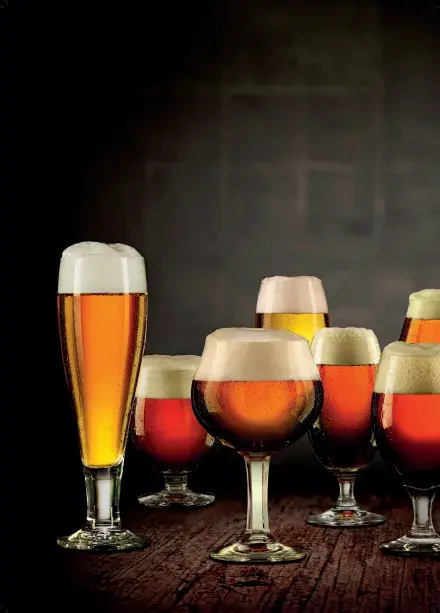
Danes have been making and drinking beer for more than 3,500 years, and it has always been the preferred drink with smørrebrød. For centuries, beer was brewed on every farm. Later, it was brewed in hundreds of breweries
You can call beer ‘liquid bread’ because both beer and bread stem from a mash of grain. If leavened, it can be transformed into bread by baking in heat. If fermented, it can be transformed into beer. In Danish food culture, smørrebrød and beer have always gone hand in hand.
With the discovery of an ancient bucket containing remnants from wheat beer, archaeologists have evidence of beer being brewed in Denmark since at least the year 1370 BC. Every farm in the olden days baked its own bread and made its own sausage, and the brewing of beer on individual farms was just as commonplace.
If you visit a Danish home today, you will often find a room called the bryggers where things like washing machines, brooms, and boots are kept. In the olden times, this room was where the beer – known as brygget – was brewed; therefore, the room was called a bryggers.
In the 1800s, small professional breweries emerged all over the country to supply this very important part of the Danish diet that was consumed by both young and old. Well water was often contaminated in those days, so it was safer to drink beer. Adults were known to consume several litres of beer daily. It should be noted that the alcohol level of the beverage was no more than 2-3%.
The quality of beer fluctuated due to a very limited understanding of the yeast and microbiological processes involved in the brewing process, a problem the French scientist Louis Pasteur helped shed light on. He discovered that it was often bacteria that spoiled the beer, and he suggested treating the beer with heat – or ‘pasteurising’ it – in order to kill microorganisms. This was a a precursor of a later discovery: in 1883, a scientist at the laboratory at Carlsberg Breweries, Emil Christian Hansen, discovered that wild yeast could also spoil beer the same
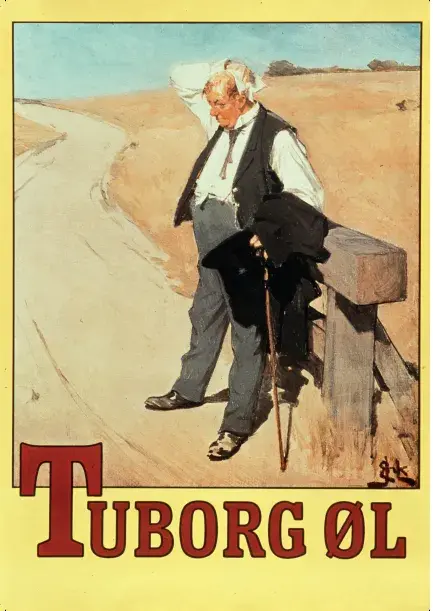
Tuborg Brewery was the first to introduce pilsner beer in Denmark, and their commercial poster ‘Tuborg man,’ from the year 1900, became an iconic symbol for beer
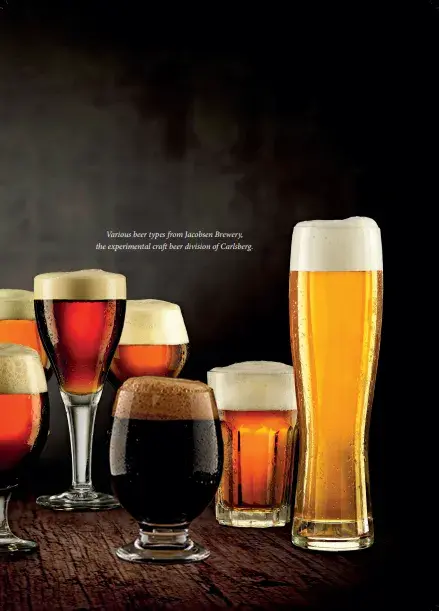
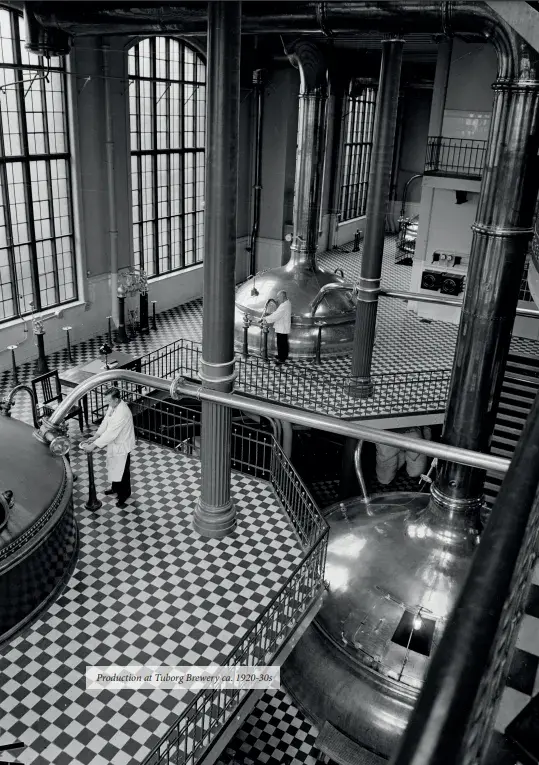
way that bateria did. He developed a method to purify yeast for better fermentation. This paved the way for a brand-new method of brewing beer, and the newly discovered yeast strain, Saccharomyces carlsbergensis, was offered freely to other breweries for their use. Since then, S. carlsbergensis – known today as S. pastorianus – became the dominant pilsner yeast among the hundreds of competing Danish breweries as well as among thousands of breweries around the world.
Carlsberg beer became world-famous and, in the 1900s, gradually evolved into being the dominant player in the Danish beer industry eventually absorbing its long-standing rival, Tuborg Breweries. Carlsberg’s near-monopoly in Denmark meant that, during the years 1970-2000, most Danes drank the same type of beer, a light pilsner.
In the new millennium however things started to change. The first sign of change was seen as early as 1990, when the steakhouse chain Hereford Beefstouw in Copenhagen established the Apollo Brewpub. At that point, there were no revolutionary recipes or ingredients in play at the brewpub, but the beer there was hand crafted and different in style from the mass-market beers known to Danes. Apart from a small percentage of beer drinkers who enjoyed the few and often strong speciality beers, the pilsner ruled the Danish beer world. Whether it was brewed by the big players Carlsberg or Tuborg, or by some of the regional breweries in the larger towns of Denmark, it would taste more or less as identical: much like a Big Mac does at any McDonald’s burger outlet around the world.
But something was brewing in those years, and in 1995, when Denmark’s first dedicated microbrewery, Brøckhouse, was founded. Carlsberg Breweries took notice, so in 1997, the brewery experimented with a special lager, Carl’s Special, to mark the brewery’s 150th birthday.
‘It started very much as a grassroots movement within the brewery,’ explains Head Brewer Morten Ibsen, who joined Carlsberg in 1996 and today heads the craft beer division, Jacobsen Brewery situated in the old original buildings of Carlsberg.
‘A few young brewers met with some marketing people, and together, they created the new Semper Ardens series which broke with tradition. In those years, you could often buy an entire case of pilsner with 30 bottles for 100 kr. (circa 14 USD), but if you wanted a bottle of Semper Ardens, you had to pay 50 kr. for 70 cl. The older brewers did not get it. They found it crazy to start brewing types of beer we were not known for. Also, the top management was not convinced that it would be possible to sell beer at this price, but the consumers received it well. This way Carlsberg actually helped change the perception of beer and price, which I think helped make way for the many microbreweries spawned in the 00s,’ says Morten Ibsen.
It is not unlikely that the grassroots at Carlsberg Brewery found nourishment from the beer enthusiasts, who were joining together to form a consumer organisation eager for a greater selection of beers Inspired by the British Campaign for Real Ale, founded in 1971. The Danish beer enthusiasts began lobbying Carlsberg in 1995, three years before they formed a formal association. They named it Danske Ølentusiaster – or ‘Danish beer enthusiasts’ – and did their best to persuade Carlsberg to begin brewing more interesting beer. This quickly turned into something of a people’s movement, attracting thousands of fans who, together, ventured into trying exotic brews.
The beer enthusiasts did what they could to pressure Carlsberg, explains Søren Houmøller, who was one of the five founders, and chairman of the association during the time when its membership grew from 5 persons to 3.000, making it the worlds second largest beer consumer organisation.
‘The media was interested in this new popular movement, and we were often interviewed. I remember one time when I had been on national TV, the communication director of Carlsberg phoned me, and asked, why the association had accused Carlsberg of making lousy beer. My answer was; ‘Because you do,’ and this did not go down well,’ Houmøller recalls, adding that later a more constructive dialogue emerged between the association and Carlsberg.
The enthusiasts started to arrange contests to award the best beers of the year. In 2000, they launched an annual festival that attracted thousands of visitors eager to sample the hundreds of beers showcased and helped build a substantial base in the market for speciality beer, which at that time was practically nonexistent. This festivals debut coincided with the aforementioned introduction of Semper Ardens.
In 2004, Head Brewer Morten Ibsen experienced something of a victory when his Semper Ardens Christmas Ale from Carlsberg was named Beer of the Year by Danske Ølentusiaster. ‘The beer enthusiasts had been criticizing Carlsberg sharply for years for making boring beer, so for me, it was a big thing to win the title in competition with other good brewers,’ says Morten Ibsen.
Semper Ardens’ success led to the creation of Jacobsen Brewery back in 2005. Compared with its parent – which produced approximately 300 million litres a year at that time – the new brewery was small. Nevertheless, Jacobsen Brewery had a capacity of 1.7 million litres, far more than any of Denmark’s other 180 microbreweries.
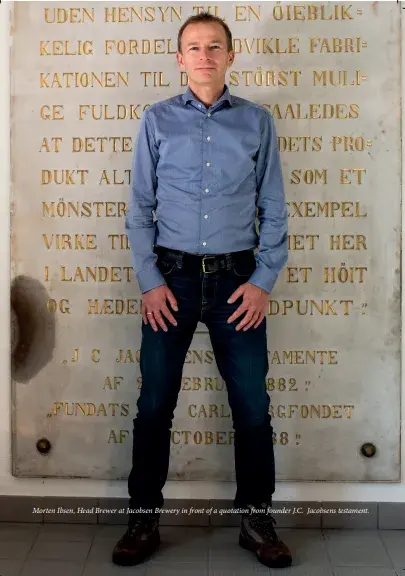
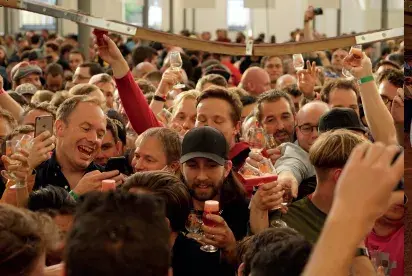
In 2012 Mikkeller created an international beer festival attracting thousands of foreign guests and dozens of foreign cult beer producers to an event for hard core beer nerds.
With know-how from Carlsberg and fresh inspiration from craft beer circles, Jacobsen became a successful supplier of craft beer in a more civilized form. It is not the type you will find on tap at the most ambitious beer bars, but the brand with its 20 or so varieties has a strong following and is popular with many smørrebrød restaurants. It is definitely a success, but Jacobsen has in no way cannibalized its parent. The Grøn Tuborg Pilsner remained the most popular beer, outselling its fancy little brother 10,000 times in Denmark and 1,000,000 times by Carlsberg Groups international sales of beer. But the Jacobsen Brewery is not about size, says Head Brewer Morten Ibsen.
‘At Jacobsen we combine science, tradition and passion into what I like to call the art of brewing, and we are becoming ever more experimental as the years pass, working with still smaller batches in order to be more creative and flexible,’ says Morten Ibsen.
Several of the other microbreweries went bankrupt in the 2000s while others were succesful, but none found success on the scale of Mikkeller, a brewery co-founded in 2006 and run by the young schoolteacher Mikkel Borg Bjergsø.
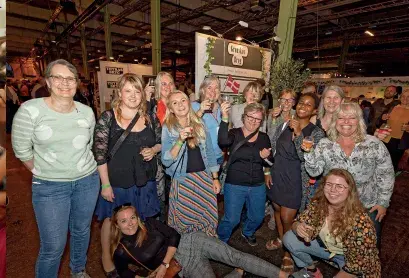
Since 1998 the association Danish Beer Enthusiasts have arranged a yearly beer festival attracting large crowds of Danes not necessarily beer geeks, just ordinary citizens with a healthy thirst for beer.
In a way, Bjergsø actually followed in the footsteps of Carl Jacobsen, who started his career as a ‘rental brewer’ paying established brewers for use of their equipment. Mikkel Borg Bjergsø did exactly the same. He became famous as a ‘nomad brewer’ who did not own any production facilities but nevertheless became world-famous in beer circles. From the beginning of his business career, most of his production took place outside of Denmark, and it is also internationally that most of Mikkeller’s fame and fortune has been made. The brewery stood out from the other microbreweries by introducing very unusual and daring beers. This created a profile that separated Mikkeller beer from the the rest of the beer universe
Up until Mikkeller’s entry in the market, the majority of beer enthusiasts were men who felt at home in the old-fashioned pubs and taverns. Mikkeller connected with the young hipster movement and managed to lend an air of funky hipness to beer’s previously dusty and stale image. This helped establish a niche for beer connoisseurs similar to the one for wine connoisseurs, but with the important difference that beer is more accessible.
Mikkeller quickly became a very successful and profitable business that today produces more than 5 million litres of beer yearly and runs a brewery in the United States, two in Denmark
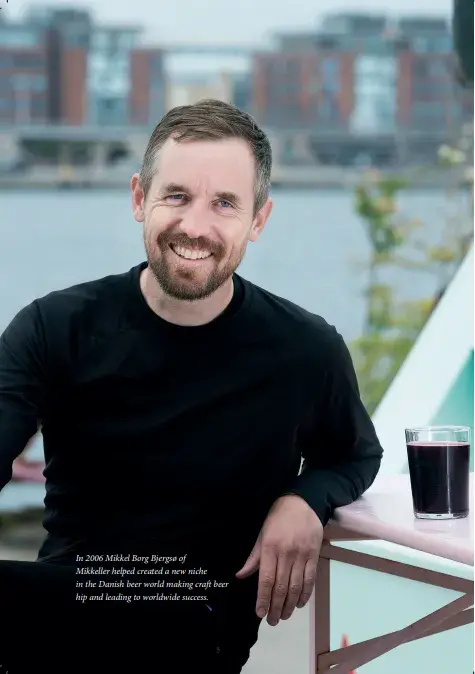
and one in Britain. Their beer is sold in more than 50 countries, among others by Mikkeller’s own bars and restaurants in more than 40 locations worldwide, albeit the headquarters and its 35 employees remain in Denmark. Mikkeller inspired many of the young brewers who set up shop in the last ten years. And while the first wave of microbreweries in the 1990-00s was fiercely competitive, the next generation seem to enjoy a greater amount of cooperation and mutual support.
‘In the early days, when I started out, I felt it was very much an ‘us against them’ situation, whereas today the breweries cooperate much more, and the scene is much more interesting right now,’ says Mikkel Borg Bjergsø, who welcomes the competition with open arms.
‘To be honest, I wondered – for many years – why nobody stood up and competed with Mikkeller. Since 2006 when we launched and until 2015, there were almost no challenger. But then things started to change with guys like Gamma Brewing and Åben, who impresses me with talented branding,’ says Bjergsø.
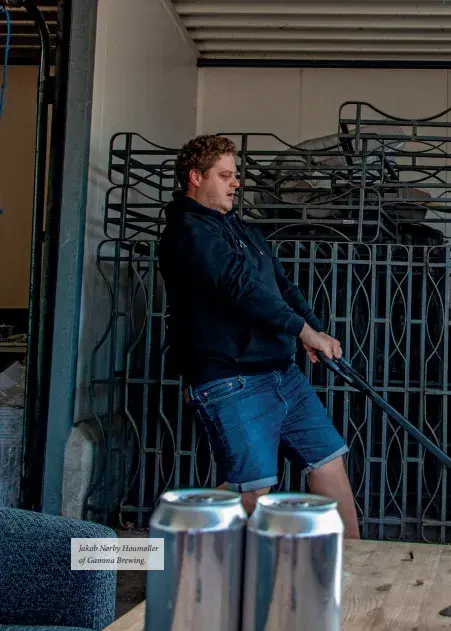
One of Gamma Brewings three founders is Jakob Nørby Houmøller. He confirms Mikkel Borg Bjergsø’s impression of a beer scene that is inclusive, and in some ways similar to Denmarks gastronomic revolution in the 1990-2000s. Here young chefs changed the landscape of gastronomy, transforming an environment of fierce competition among chefs and restaurants to one in which cooperation and knowledge sharing reigned.
‘I don’t see the other breweries as competitors. We all have the same goal; make people drink better beer, and making great beer is what occupies our minds. When my partners and I started out, we received all the help we needed from other brewers, all you had to do was ask, then somebody would help you,’ says Jakob Houmøller.
Since its start in 2015, Gamma Brewing has been located in a defunct dairy, where several independent brewers have their own tanks lined up. But thanks to rapid growth, Gamma is breaking away, and will soon move into a brand new 1.5 million euro brewery, which is a symbol of the young brewery’s financial success. Gamma has been a profitable venture from the start, and even though the beer is sold at the markets highest prices, consumers are happy to pay the premium price since the product is out of the ordinary.
Before they launched their own place, the three partners worked as bartenders in various beer bars, Denmark is blessed with lots of such specialized beer bars offering lots of variety, as well as several eateries where beer and food are paired. Of course, this is also the definition of a smørrebrød restaurant, but in the case of brewpubs like Warpigs and Nørrebro Bryghus in Copenhagen, smørrebrød is not the focus.
Copenhagen and other Danish cities host several annual beer festivals. In 2001, as mentioned earlier, Danske Ølentusiaster founded the Ølfestival, or ‘Beer Festival’, where thousands of guests could taste hundreds of speciality beers. Each year, the event’s popularity grew, the latest version in 2019 attracted 14,000 visitors who could sample more than 1,000 different beers from more than 200 breweries.
Mikkeller launched, in 2012, a festival called Beer Celebration that concentrated on craft beers from around the world. This grew into a successful event attracting mostly international visitors eager to taste some of the world’s most sought-after craft beers. From the beginning has not been on Danish beer: most of the breweries represented are foreign, attracted by Mikkeller’s worldwide fame.
In 2020, a new festival with broader appeal was launched alongside the Mikkeller Beer Celebration. Called Copenhagen Beer Week, it is arranged by the Food Organisation of Denmark in cooperation with more than 30 Danish breweries. This collaboration displays the diversity of the Danish craft beer scene, which has never been stronger.
The count of breweries reached 216 in 2020, exactly 100 more than a decade ago and more than 200 more than in the year 2000. The number of private hobby brewers is estimated to be around 5,000 out of Denmarks population of 6 mio., so it is safe to say, thet the Danes have preserved their historic thirst for beer.

I had to leave several places off the list, since the decision was made to mention only 50. But there is one restaurant, that I would have liked to include, had it only been open: Palægade restaurant, which burned down in early 2020. It will reopen with a strong team, but only after this book went into print.
Also I had the restaurant at Hotel Baltic in Als high on the 50 Best list. But just before going to print, I learned that the current owner would be closing the hotel, and the defining smørrebrød chef, Chris Franklin, would be leaving, so I chose to strike Baltic from the list. I would also have liked to include the Spisesalon Restaurant in Aarhus, but this place has been temporarily closed for months due to the corona virus situation.
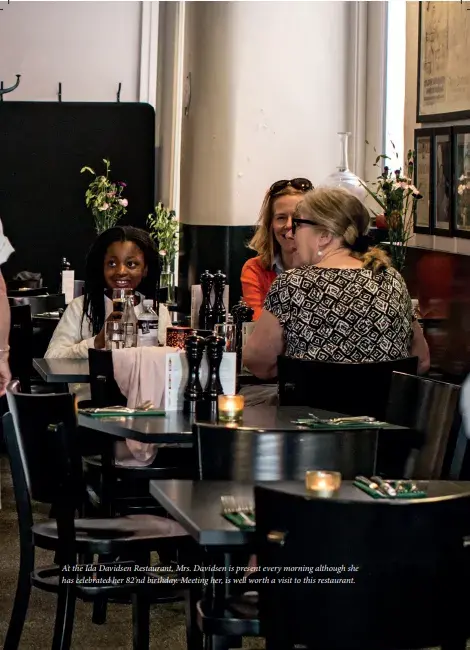
I also wish to make an honourable mention of the Ida Davidsen restaurant. Not so much for the food as for the ambience in this unique institution in the history of smørrebrød.
Visiting reminds me – a long-time fan of cruise ships – of the RMS Queen Mary ocean liner, where I spent a night a few years back. After crossing The Atlantic 1001 times she was docked in Los Angeles and converted to a hotel and restaurant in 1967. Queen Mary went into service in 1936, just one year before the birth of Ida Davidsen, known for 60 years as The Queen of Smørrebrød. Mary was a grand lady, and on top of that one of the worlds fastest cruise ships, just as Ida was the leading smørrebrød lady for decades, and its most important international ambassador. And while smørrebrød was suffering in the 1970-80’s, she kept the traditions alive and inspired new young smørrebrød chefs.
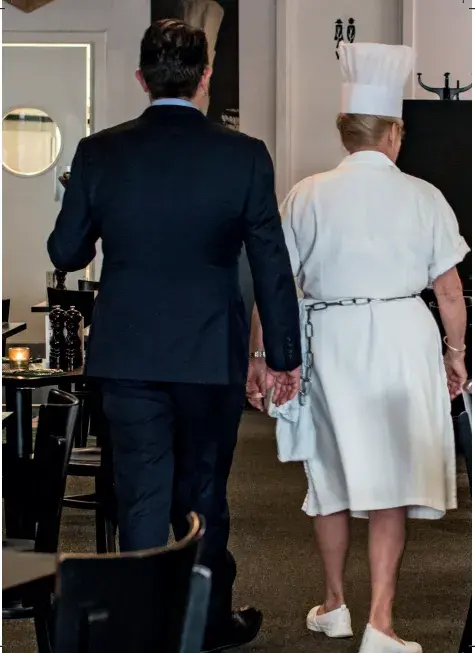
Ida’s restaurant, now run by her son Oscar, is no longer a leader in the industry, but to eat here, and enjoy the sight of the Grande Dame in her chefs whites and tall white hat, is like looking into history. So go visit her, and while you are there, have the Dyrlægens Natmad (Veterinarians midnight snack), the iconic smørrebrød invented by the Davidsen family.
After paying tribute to this historic institution, go ahead and explore the many new extraordinarily good places for smørrebrød. Please enjoy
Directly translated, smørrebrød means ‘buttered bread’. After bread, butter is the second most important ingredient. If you leave it out, it simply isn’t smørrebrød.

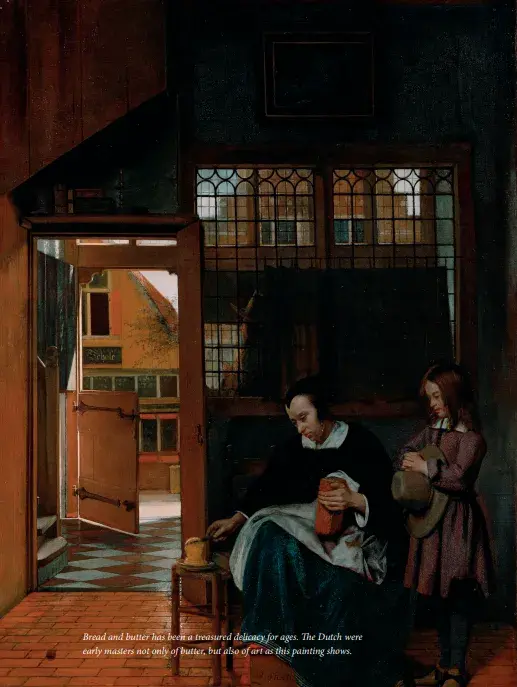
Why is butter important? Chiefly because it tastes good when it is fresh and made well from good milk. This is not a given, as butter comes in many quality grades, and sometimes you will be served ‘butter’ that isn’t even butter but is rather margarine or a mix of butter and oil. Butter also enhances the taste of bread and toppings, so removing the butter from smørrebrød is like removing the seats in a car, the heels on a pair of stilettos, or the sunshine from summer.
Traditional rye bread needs a layer of fat to become really delicious, and butter builds a connection between bread and the toppings, bridging both taste and structure. Also, the butter layer prevents the bread from becoming soggy. This was an important function during the hundreds of years when Danes would bring smørrebrød to work or school, which everybody did until recently when competition arose from new food places like burger bars and pizzerias.
Butter has been around for about 5,000 years. The Vikings called it smør, which is related to the English smear, meaning ‘fat stain’. But where the English adopted a version of the northern word for bread, which is brød, they leaned toward the Greek word for butter: bouthyron.
The Vikings were known to bring bread and butter along on their voyages, and they produced butter in England during the Viking reign, which lasted from around the year 800 to 1000. Once they rid themselves of the Vikings, the English, it seems, were able to turn to more trivial matters such as the quality control of butter. Around this time, the English King Athelstan issued a law making it a crime to falsify butter, this law later inspired certain local communities in Denmark to impose similar laws. In the following centuries, butter became abundant in Denmark; in 1128, the Danish Bishop of Lund had an entire ship loaded with butter to send to his German colleague Otto von Bamberg.
Butter was a seasonal product, since milk was only available in summer when the cows had calves. So it was important to conserve the milk for use in the long winters. This was done by making cheese and butter, and the latter was most popular in Denmark for hundreds of years until the Dutch technique for cheesemaking became known to the Danes.
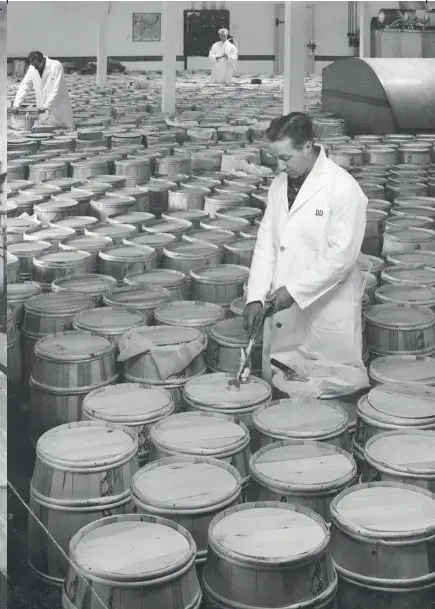
Until then, butter was the preferred conservation method, and it was kept in a salty brine where it could be preserved for months.
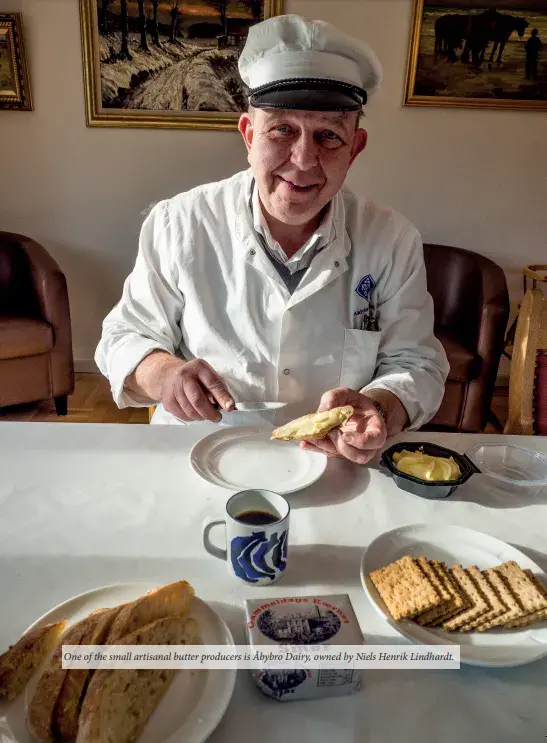
Every farm would make its own butter by collecting the scant cream from the milk over several days and waiting until there was a sufficient amount for churning. Niels Henrik Lindhardt from Aabybro Dairy, whose family has been making butter for generations, describes this process:
‘In the old days, the wealthiest of peasants had a cow or two which they would milk daily, skim off the cream, and leave it in a warm place in the house. This was repeated daily until there was a bucket of cream, which would naturally go sour. This soured cream would be put in a small wooden churn, a kind of wooden barrel with a lid, in which the cream would be stirred with a wooden pole until it sometimes separated into butterfat and buttermilk,’ says Lindhardt, smiling as he explains.
‘It did not always work, since there were several factors that needed to be in order. For example, it was important that the woman operating the churn had fastened her skirt to the left, and it certainly helped if she possessed the gift of ‘butter luck’, something that could be enhanced if she, as a small baby, had been holding a churn stick while she nursed. Another important factor was to avoid witchcraft, and this could be helped by placing a toad under the churn. People simply did not realize that if the cream went past sour and into the rotting state, it could not be made into butter. My great grandmother didn’t either, but in the next generation, they got wiser thanks to the technical developments,’ says Lindhardt.
Historically, there were two quality distinctions: ‘peasant butter’ and ‘mansion butter’. The mansion butter came from large farms with big supplies of milk that made it possible to produce the butter from fresh cream, whereas peasant butter could often be stale due to the previously described production method. In general, Danish butter was not very good 150 years ago. In England, Danish butter was called ‘mast butter’ to signal that it was best suited to greasing the wooden masts on ships. Often, merchants would sell Danish butter under names that concealed its origin. One name, ‘Kiel butter’, was taken from the German port south of Denmark from which butter was often shipped.
The foundation for the breakthrough and worldwide fame of Danish butter was likely the investment in the education of farmworkers. In the 1700s, the first institution for the education of farmers and the promotion of new knowledge was formed. Later, via the Folkehøjskoler or ‘Folk high schools’ established around 1850, there was a new education system aimed at adults, helping to build a workforce that had more skills and knowledge than ever before.
The quality of Danish butter began to improve, along with the export market, which started to boom in 1879 when butter from Denmark won the two highest prizes at a butter competition during the International Agricultural Exposition in London. But the real breakthrough in Danish butter production came in 1882 when a small group of farmers in the Jutland town of Hjedding joined forces. They established a communal dairy centred around a newly invented machine that separated cream and milk automatically.
The communal dairy in Jutland was successful. Soon, other milk producers around Denmark followed its example and set up their own communal dairies, which became the norm in the industry. Butter exports exploded from 12,000 tons in 1882 to 78,000 tons in 1900, making one of the world’s smallest countries into the world’s largest butter exporter.
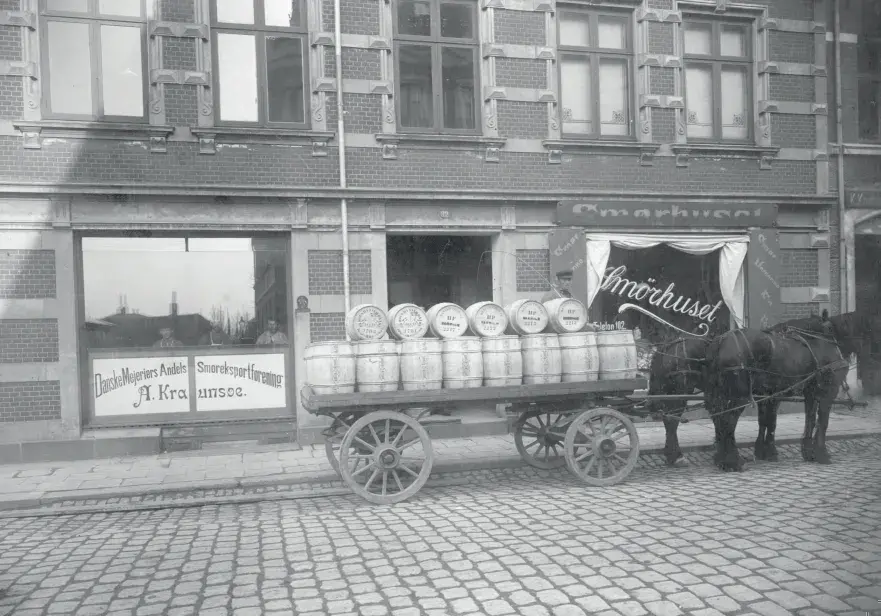
No longer was it necessary to sell Danish butter as ‘Kiel butter’. The previously unwanted Danish butter would now sometimes be counterfeited, when butter from other countries was sold as being Danish. This led to a group of producers establishing a private association with strict quality controls. It attracted almost all of Denmark’s dairies, and around the year 1900, more than 1,000 individually-owned butter dairies would export their products under a common brand: Danish Butter.
To use the brand name, the butter had, of course, to be made in Denmark. It also needed to be made from pasteurised cream, contain 80% fat, and have nothing added to it but salt. Also, the flavour quality had to be very high to meet the strict standards laid out by the team of inspectors roaming the country by bicycle and horse carriage to visit the dairies. This control system made the producers aware of the importance of quality: they risked losing access to the lucrative export markets if they did not live up to the organization’s criteria.
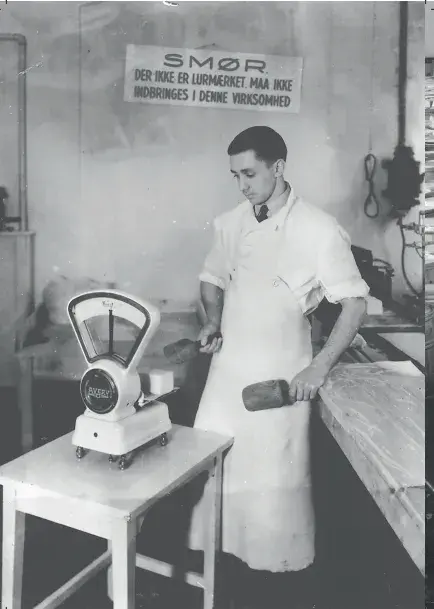
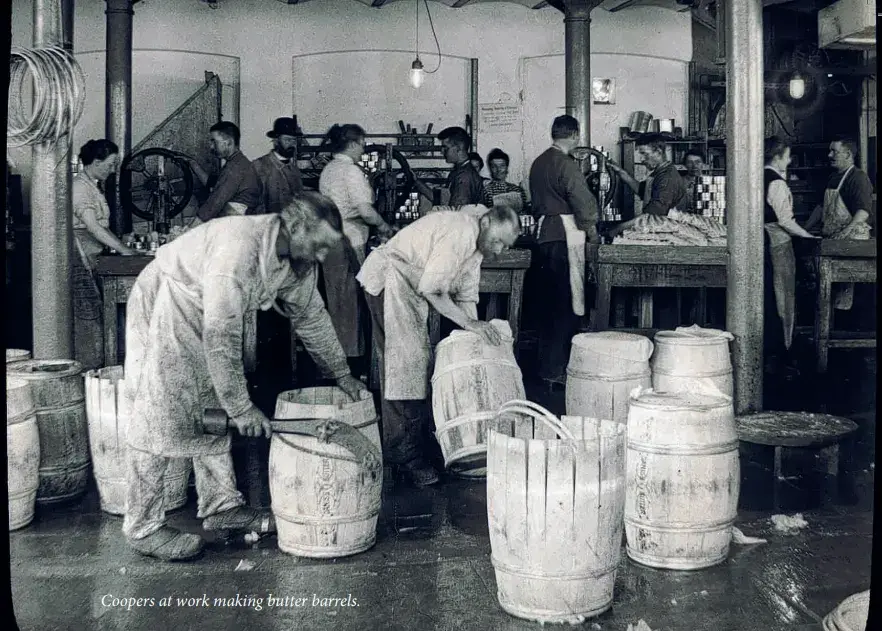
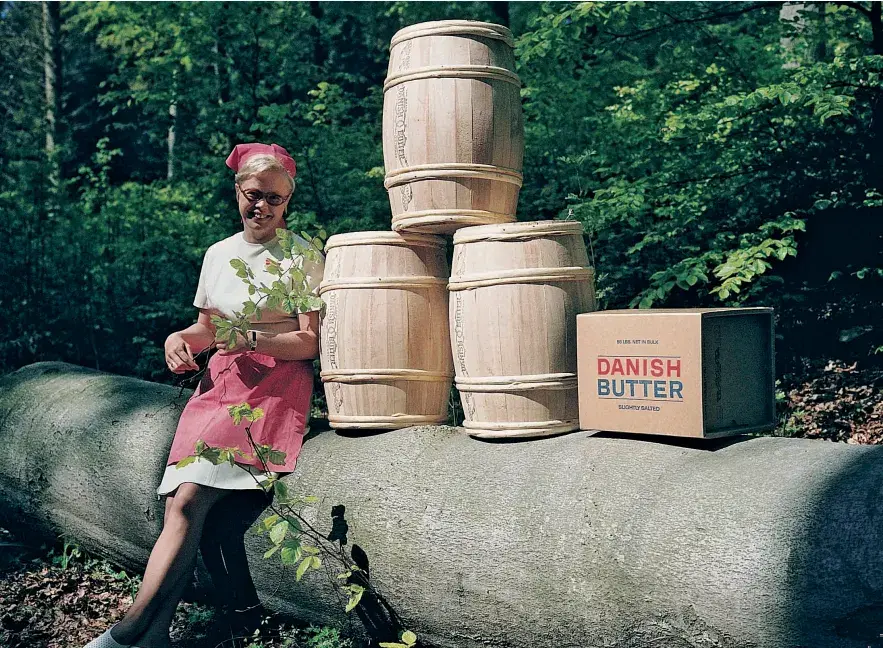
The system worked. It enabled the Danish Butter Association to maintain a high and uniform standard even though the product was delivered by more than 1,000 different dairies by the 1930s and 1940s. The Danish Butter Association took a Bronze Age musical instrument called the lur as its logo, and it imprinted the Lur brand name on the wooden barrels in which the butter was transported. In 1906, the Danish government introduced a law declaring that only Lur brand butter was allowed for export. This law further cemented the quality control of exported butter.
The quality control was very strict. Inspectors would make unannounced visits to milk producers throughout Denmark to check if the quality of the milk was satisfactory. And every week, a thorough control tasting of the finished butter was arranged. Here, a number of trained butter judges would blindly taste and evaluate whether the quality lived up to the established standards, and this method continues to this day.
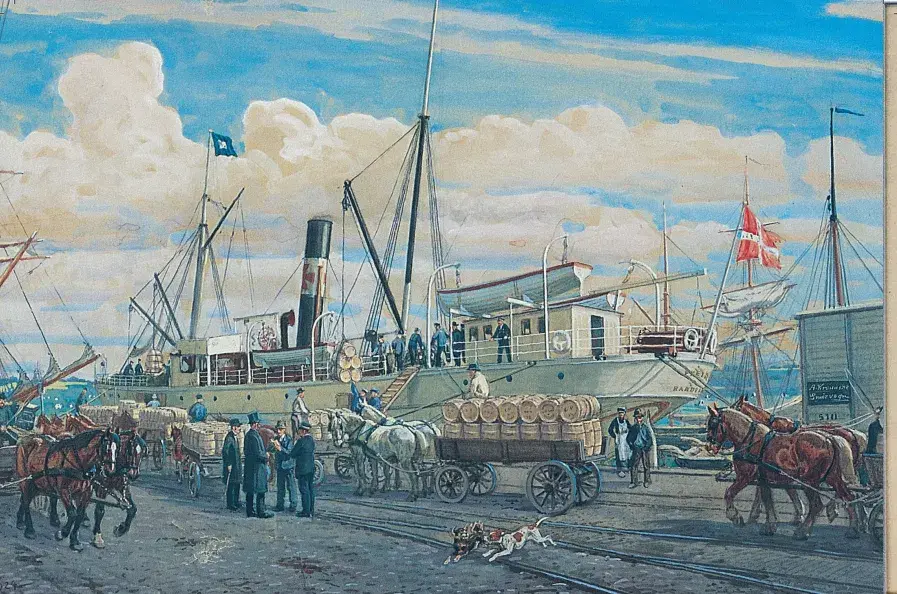
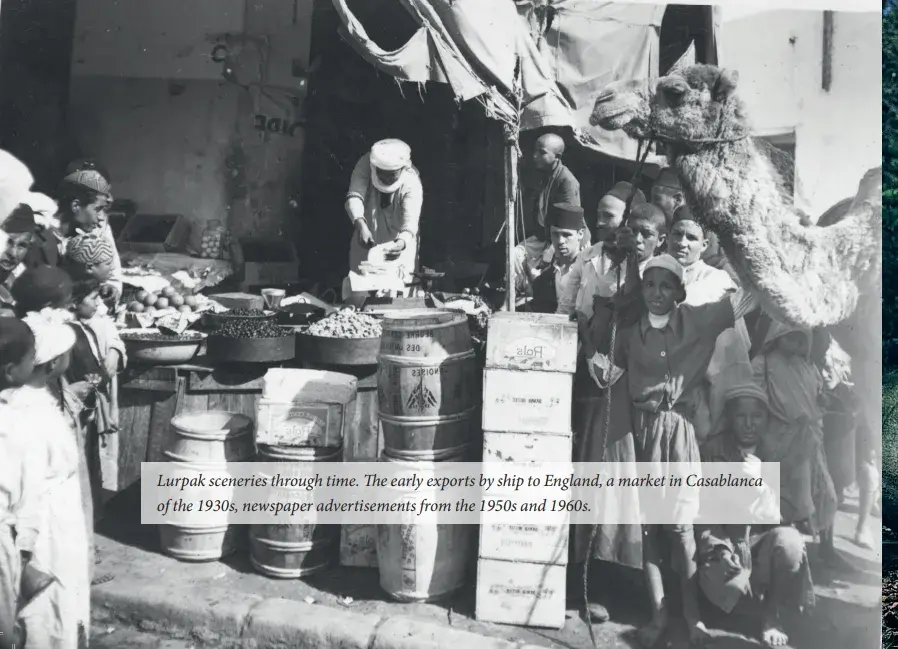
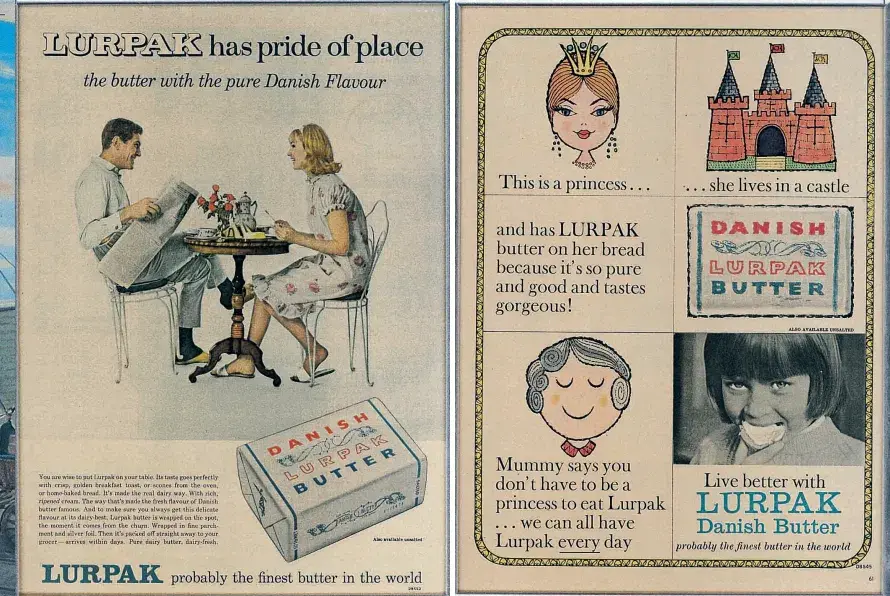
Control of Lurpak butter is not based on personal preferences but rather on a defined set of characteristics and technical qualities, explains Lars Johannes Nielsen, who is in charge of the control tastings. ‘When we perform the tastings, it is not so much about taste preferences, as about technical quality. The judges performing the assessment have been trained and tested to make sure they know and can taste the nuances in butter flavours and off-flavours, and that they do not judge based on their personal preferences,’ says Nielsen.
To be precise, the judges must evaluate the butter to make sure it meets several criteria: ‘In the assessment of Lurpak butter, the judges must relate to a specific set of instructions, regarding appearance, taste and texture. They are trained and know exactly how Lurpak should look, feel, and taste. A pure, fresh and creamy butter flavour, smooth appearance, and consistency are key to Lurpak and thereby the key to a good grade. These characteristics are all described in the instructions for each butter type. Unsalted butter has one set of rules, salted another, organic butter a third, garlic butter a fourth, and so on. Organic butter is made from cows given a special organic feed, and this is something the judges must consider. For example, a cow given lots of grass in the summer will have this feed shine through in the taste,’ Lars Nielsen explains.
Lurpak butter is by far the most sold and exported Danish butter, but when blind tastings with consumers or chefs are arranged, Lurpak is far from a guaranteed winner.
‘If you put 30 consumers in a room and serve Lurpak and more artisanal types with extra salt and sourness, these may often win since they have a much more defined taste, as do the special Lurpak variants with extra salt. But in the long run, the traditional Lurpak varieties are the most popular, because the quality is consistent,’ says Nielsen.
Comparing the classic Lurpak butter to the artisanal types, is almost like comparing apples to pears. They are two very different things. And while in some cases you may prefer the rich, slightly sour, and extra-salty taste of artisanal butter, in others you may enjoy the clean taste of fresh cream that you get with unsalted Lurpak butter.
To a large extent, the story of the Lur brand is also the story of Danish butter in general because the Danish Butter Association controlled almost the entire production of butter in Denmark since the Lurbrand’s creation in 1901, and over the next 50 years, it came to set a world standard for good quality.
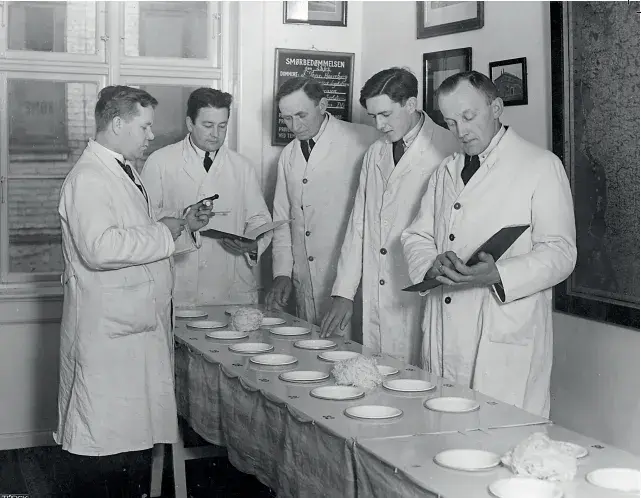
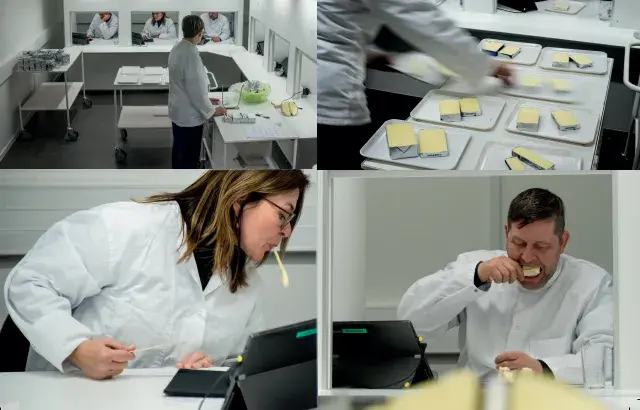
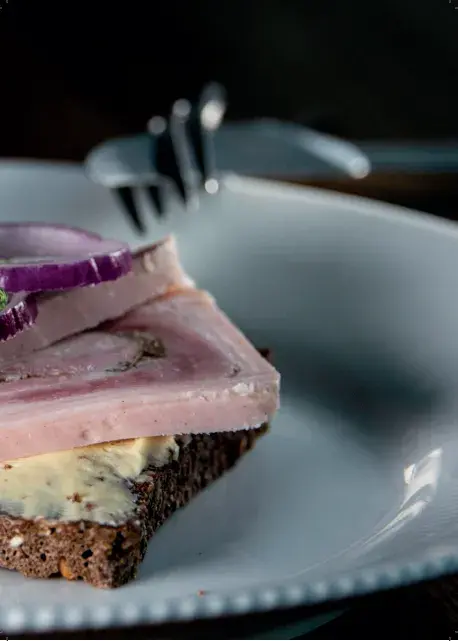
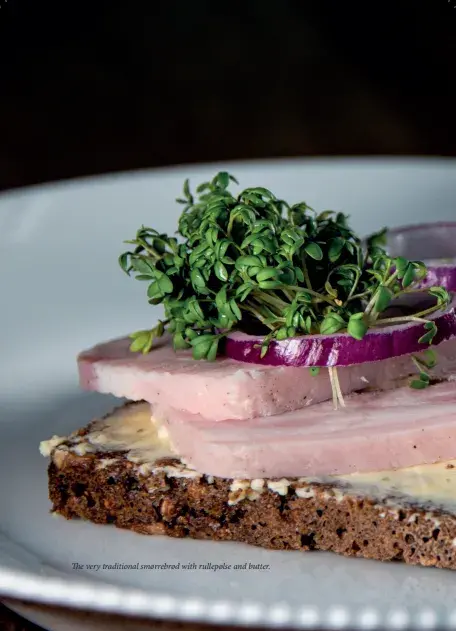
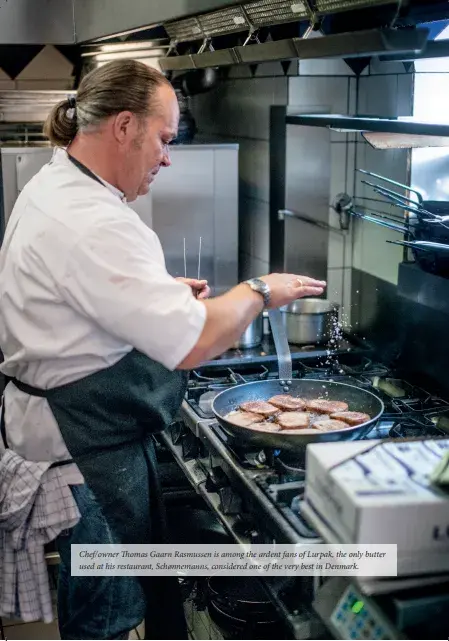
Lurpak butter spread to most parts of the world, packed originally in wooden barrels for closer markets and in tin cans for longer journeys. In the 1950s, a new, more hygienic packing system replaced the old-fashioned 50-kilogram wooden barrels with 250-gram portions. In 1975, another new technology, the continuous butter-making machine, improved quality even more. Instead of feeding the machinery ‘soured’ cream it was fed fresh cream, which had the souring fermenting bacteria added afterwards, a technique that made it possible to produce larger amounts faster, further diminishing the risk of oxidising the butter. It increased freshness, but at the cost of some of the depth of flavour of old-fashioned butter, where the cream is ‘soured’ – or fermented – for 24 hours before entering the churn.
The continuous butter-making machines have the advantage of operating very quickly and precisely, which is ideal for large-scale production since it assures a consistent texture. Old-fashioned traditional churns have a much smaller capacity, and the quality of the butter varies, but it often has a richer flavour with more aromatics and acidity. Also the structure of the old-fashioned churned butter is less even than that of butter made with the continuous butter making machines which produces a more even and firm texture.
But in the 1980s and 1990s, a growing number of consumers started to ask for organic dairy products, just as old-fashioned churned butter gained popularity among chefs at gourmet restaurants and among discerning consumers. This created a following of customers who cherished the strong and well-rounded taste of old-fashioned butter, which would never have passed the technical quality control of Lurpak.
One of the small dairies that stopped delivering butter to the Lurpak association was Aabybro Dairy, as owner Niels Henrik Lindhardt explains.
‘In 1984, we left the Lurpak since we could not live up to the new quality demands without investing in a continuous butter maker. With this machinery, you can obtain a much longer shelf life than our butter. That is important for Lurpak, which is sold all over the world, but not for us, since we sell our butter locally,’ explains Lindhardt, who found a niche in supplying the butter to restaurants in large catering packs. With this he introduced a new product that inspired many other producers, both small and large. Aabybro Dairy was also a pioneer regarding the now-popular type of gourmet butter made with the addition of large salt flakes. Aabybro Dairy uses a special salt from the island of Læsø, but others have since made similar butters with other types of salt, and Aabybro has won many local competitions with this butter.
Another small player, Øllingegård Dairy, was similarly successful in 2006 and 2008 when they entered their organic butter and won at the international butter competitions arranged by the Wisconsin Cheese Makers Association.
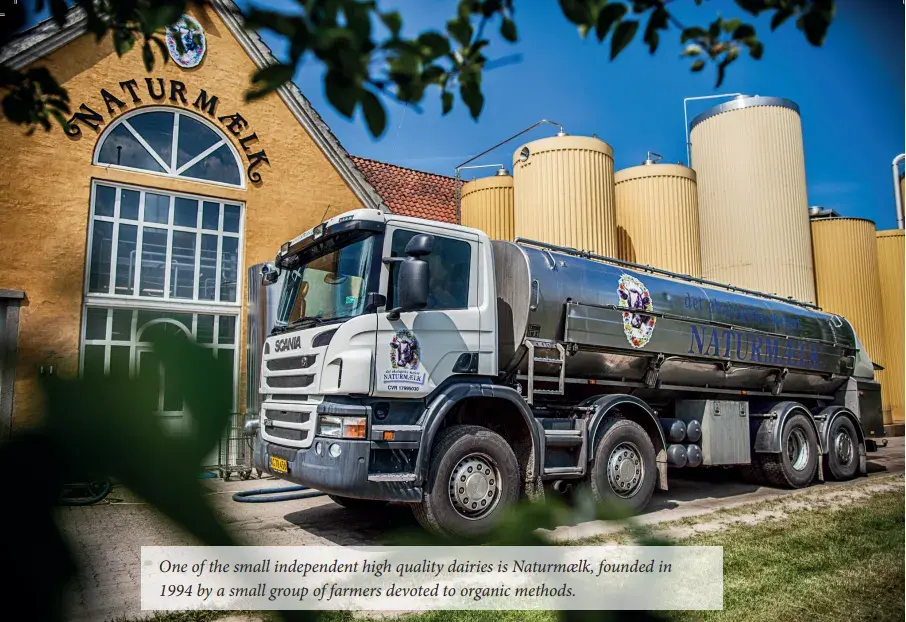
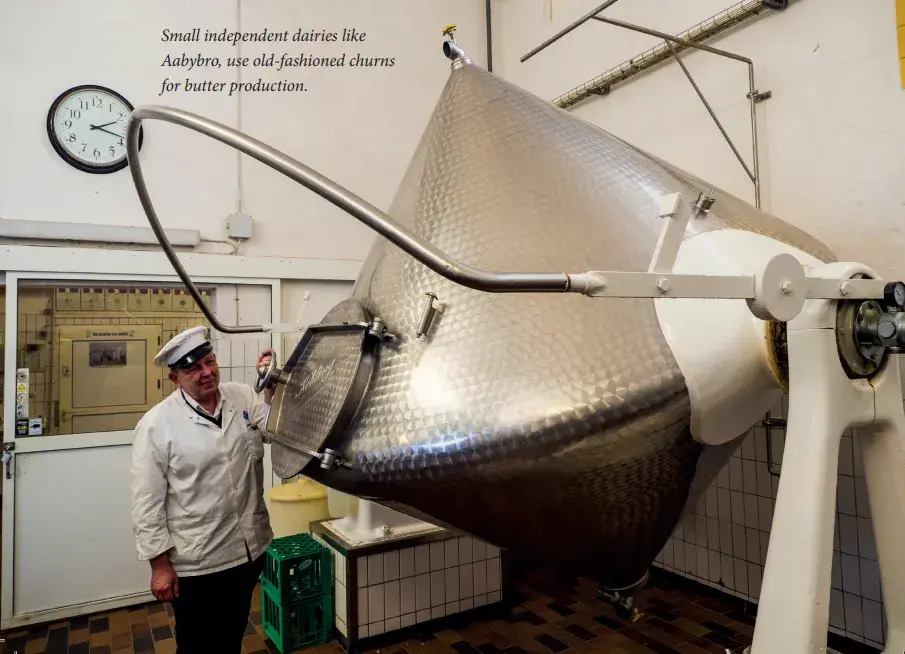
These small producers were following in the footsteps of Lurpak, which became famous by winning prestigious titles more than 100 years ago. Lurpak has continued to win titles to this day. The latest victories came at the Wisconsin Cheese Makers Association competition in 2020: Holstebro Mejeri won for the best unsalted butter, and Bornholms Andelsmejeri placed second in the salted category.
The traditional Lurpak suppliers – all farmers who jointly own Denmark’s largest dairy producer, Arla – were slow to adapt to the new market demands for organic milk and butter, since organic milk has a distinctive taste that does not fit into the list of rigorous standards for Lurpak. Eventually, though, they acceded to the market demands, and Arla introduced an organic butter as well as other special butters that match the quality of most small competitors.
Since 2012, the Lurpak brand has been owned by Arla. They keep the traditions for rigorous quality control alive by entrusting the control process to an external industry organisation, called the Danish Dairy Board, which monitors the quality. With a market share of around 50 %, Lurpak is the largest butter brand in Denmark but far from the only one. There are a number of small independent dairies, a few of which manage to maintain an independent profile and sell products under their own label while simultaneously delivering milk to the large Arla dairy.
Outside of the Arla circuit are small, respected butter producers like the previously mentionedÅbybro Mejeri and Øllingegård, as well as Ingstrup Mejeri and Naturmælk. Naturmælk is, following Danish dairy tradition, owned by a collective of 33 farms that supply milk. All these producers are organically certified, and a number exceed organic requirements by also following biodynamic principles.
Deciding which butter is best is a daunting task. Those who prefer the old-fashioned style may find Lurpak nondescript, while Lurpak fans may find the old-fashioned butters too rustic. The dilemma is like asking which is ‘best’ between a painting by Renoir and a photograph by Henri Cartier Bresson. I dare argue that no matter how you look at it, it is very difficult to find Danish butter that is not high quality.
And please remember: if the bread is not buttered, it may taste nice, but it isn’t smørrebrød.
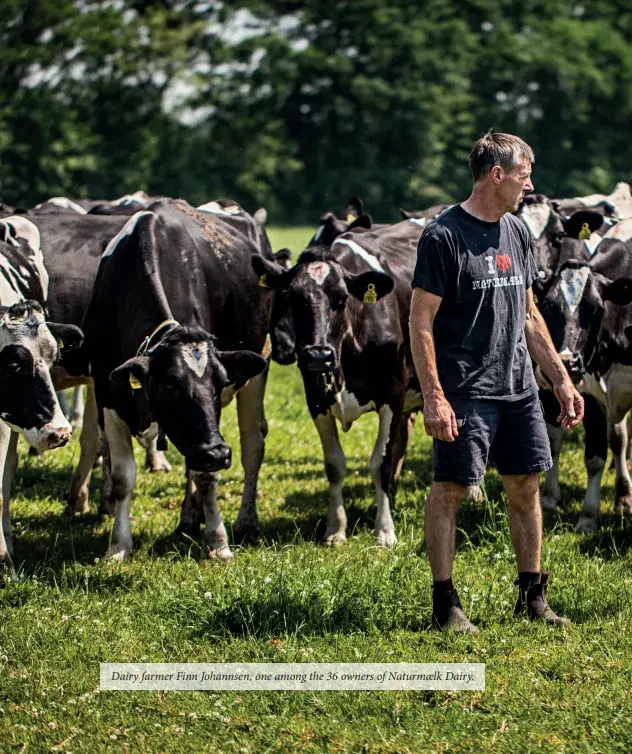
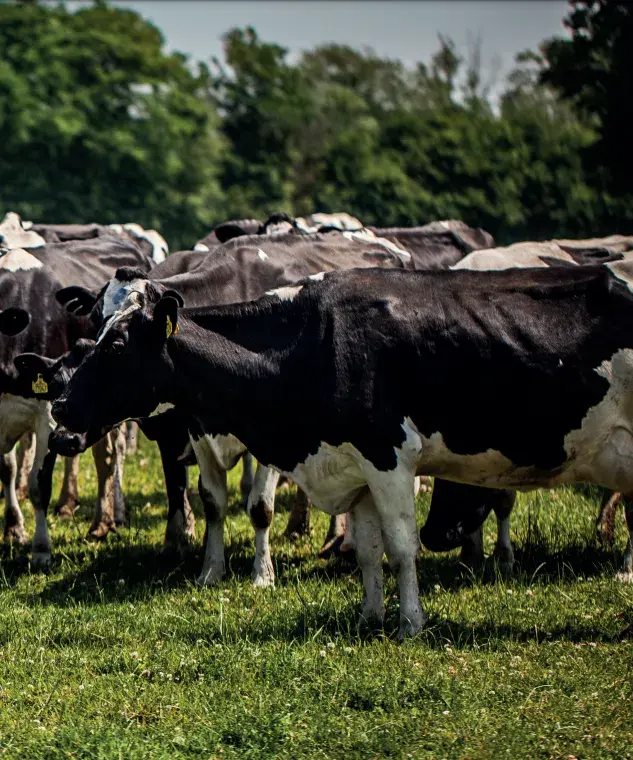
The most important ingredient in smørrebrød is rye bread,
one of the most significant foods in the history of Denmark
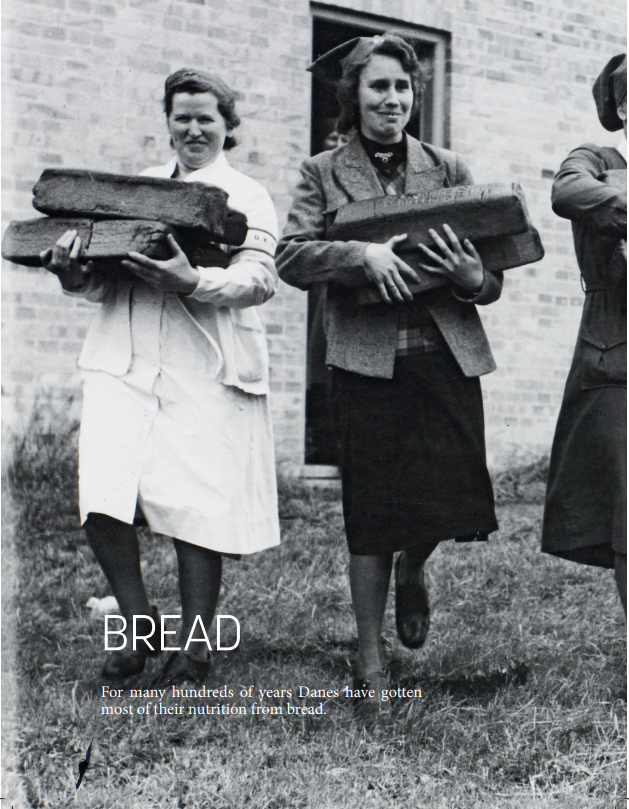
The Danes invented smørrebrød, but they have no claim to being the first when it comes to baking bread. The earliest trace of bread baking in Denmark was found in Jutland in the form of a 2000-year-old clay oven similar to the kind used in the Middle East for baking flatbread. During the Viking age, rye became dominant, the dough was leavened and baked with the use of ovens, making way for rye bread as we know it, and for several hundred years, the word‘bread’ meant ‘rye bread’
As villages and towns formed, central bakeries emerged and people would bring their own dough to be baked. As commercial baking emerged, authorities began to control both the quality and the price of bread. There were examples of unscrupulous bakers who would add foreign objects like sawdust to keep costs down, and some would use portions of lesser-quality barley without declaring it. So laws were passed to regulate how much rye a loaf of rye bread must contain, and the bakers were obliged to stamp their official seal on their bread. Thus, it was easier to investigate fraud; if caught, perpetrators would be heavily fined. If the crime was repeated three times, the baker’s oven would be taken apart and destroyed. Bread was serious business.
For the common Dane, bread was synonymous with rye bread. However, in the late 1600s, white wheat bread started to appear in Denmark, inspired by baking in the Netherlands and France. Since everything French became fashionable in the 1700s, the bread became known as franskbrød meaning ‘French bread’. The common people, however, called it ‘cake’, as it was a luxurious treat often made with milk and egg.
For hundreds of years, Danish rye bread has been made predominantly with rye, sometimes mixed with a small quantity of wheat to introduce a slight airiness and soften the rather distinctive rye taste. Rye bread has generally been put into two categories: one just called rugbrød, and the other called fuldkorns rugbrød, which means that the flour has been mixed with whole grains.
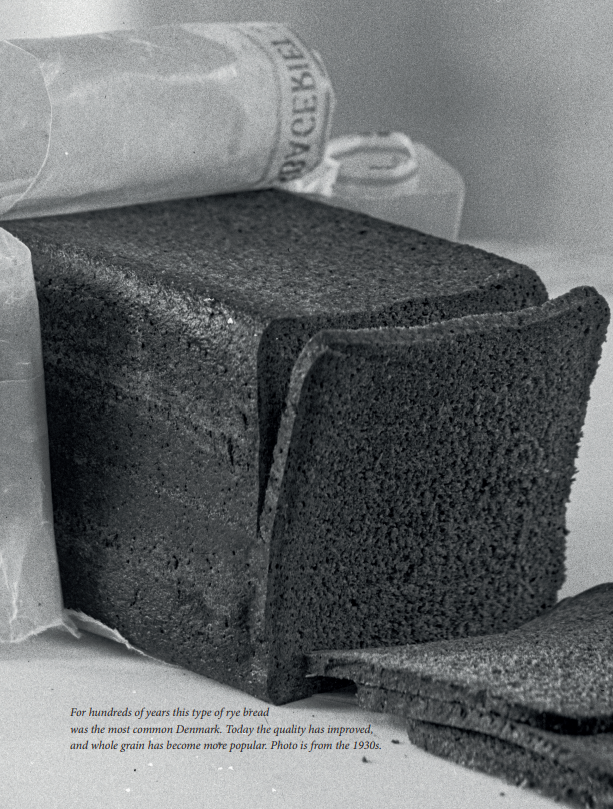
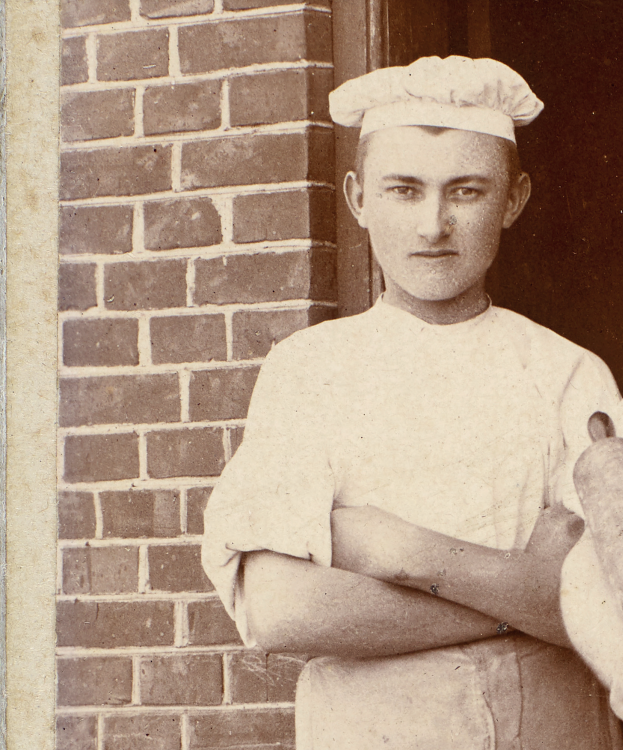
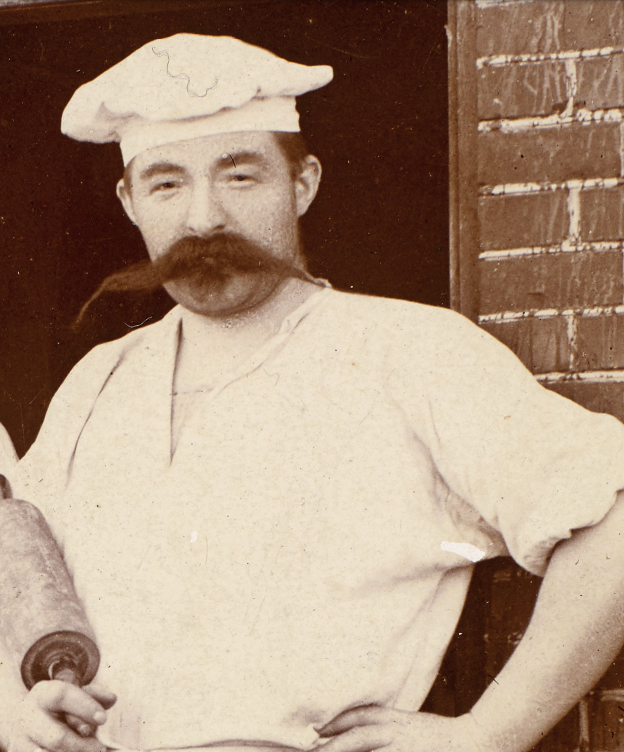
‘There are people who think that smørrebrød is good if it has good toppings. This is wrong. The secret to fine smørrebrød is very simple; it doesn’t matter what is on the bread, as long as the bread is good.’
– Mogens Lind, poet and influential gastronome, 1947.
Up until the late 1800s, rye bread was leavened with sourdough. In 1880, though, this technique was altered thanks to the efforts of entrepreneur Viggo Schulstad, who founded Copenhagen’s first industrialised bread factory. The rye bread in those days had a markedly sour taste. One might humorously suggest that this was because the dough had been kneaded by barefoot men, which was actually the case, but this method was replaced by Schulstad with modern kneading machines.
The sourness was due to the use of sourdough as a leavening agent, something Viggo Schulstad abandoned as he shifted to a new method based on baker’s yeast, a modern invention made possible by Louis Pasteur’s research in the 1860s. By combining yeast and sweet malt extract, Schulstad achieved an efficient leavening without the sour taste.
This type of rye bread was slightly sweet. It became very popular and eventually altered the Danish style of rye bread. This was partly because of the sweeter taste and partly because the industrial bakeries used a square baking tin which produced square bread. The shape of rye bread had previously been more oval, round, and large. The modern square form was efficient during production, and in those years when packed lunches became popular, it was much easier to pack the square slices.
Bread factories similar to Schulstad’s became dominant over the years, especially as supermarkets gained popularity. Small bakeries co-existed successfully and were generally known for a higher quality than the industrial bread that most Danes ate for lunch.
In those days, rye bread was not coveted: it was mainly a vehicle for toppings, and it would generally be cut in thin slices, especially at restaurants. Rye bread was an obligatory ingredient under the toppings, seldom praised in its own right. The majority of rugbrød was baked at a few factories since the baking industry had been consolidated.
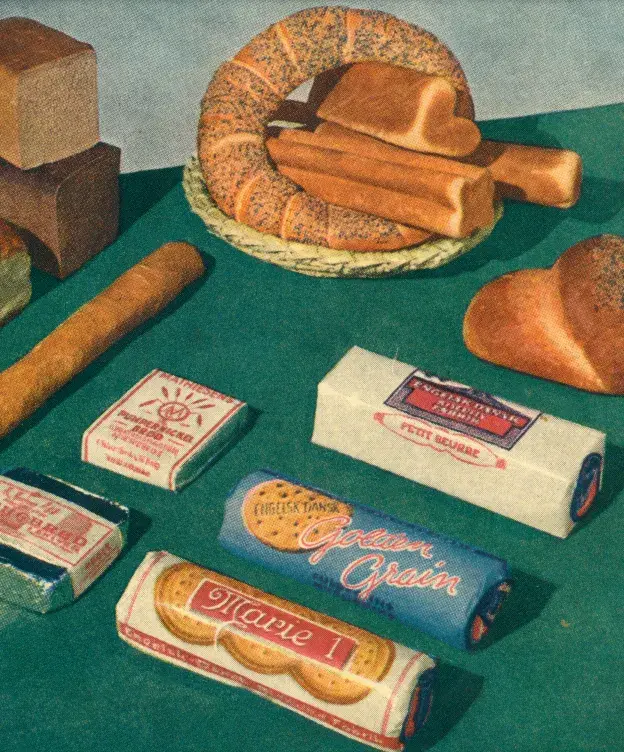
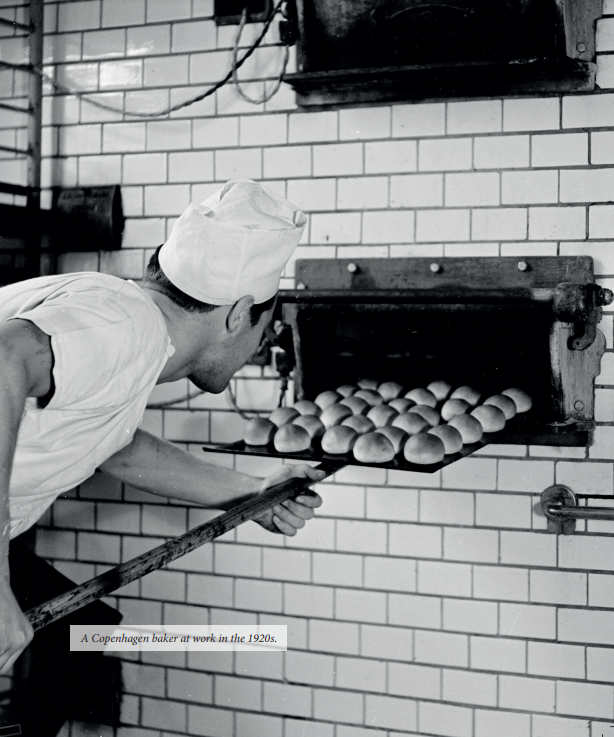
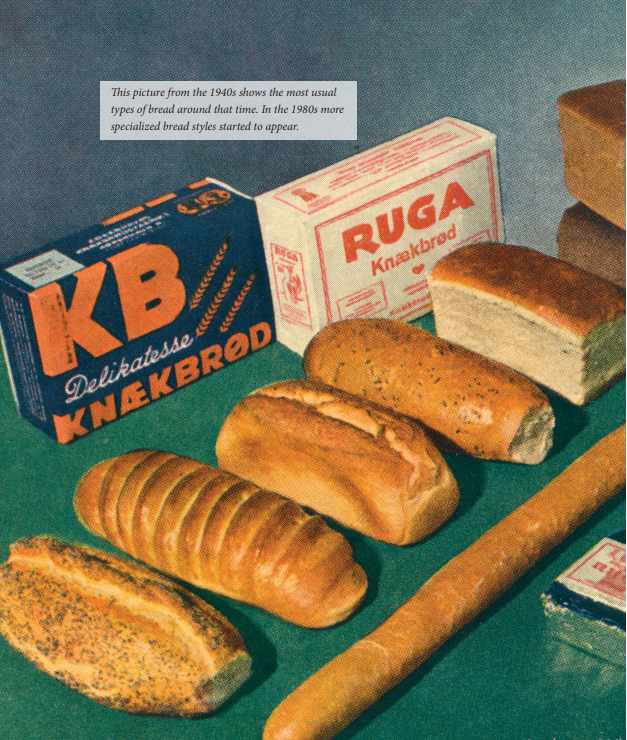
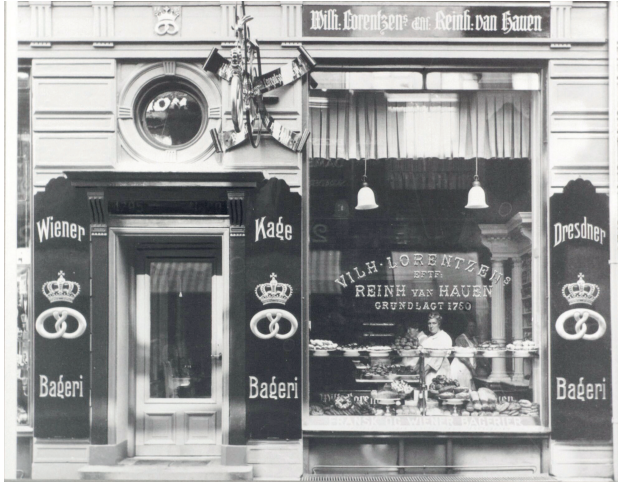
From the 1940s to the 1990s, you would find the same type of industrial rye bread in most of Denmark’s smørrebrød restaurants. Nobody cared if it was fresh, and it was often several days – or even weeks – old. But a development began in the 1980s that saw more types of bread become available as Danes started taking a bigger interest in taste than ever before. Gourmet restaurants became more numerous, and this started to rub off on bakeries, which began introducing more exotic types of bread. At least, the names were exotic. The bread was usually a product made with instant mixes given to all bakeries by the same few suppliers. In essence, a focus on craftsmanship was close to non-existent, although the bakeries made a point of calling themselves ‘artisanal’.
There were a few exceptions. In Copenhagen in particular, you could find small, independent bakeries that delivered high-quality bread to the relatively small group of discerning customers who took delight in its quality. One of these small, artisanal bakers was Reinhardt van Hauen, which was regarded as one of Copenhagen’s finest. This reputation lasted up until around the 1980’s, when new competition arrived.
One of the pioneers in what can be called the ‘bakers’ revolution’ was the young baker Ole Kristoffersen who opened for business in 1991. He was one of the first traditional bakers to stop using the industrial ready-made mix that dominated the business. Instead, he focused on a more artisanal style. He demonstrated his commitment to craft by moving the kitchen – traditionally hidden in back – inside the shop so that customers could follow the baking process. He also introduced a new type of stone oven which further improved quality.
Five years later, the bar for quality rose further when respected gourmet chef Per Brun entered the business. He bought an existing bakery and started to sell a sourdough wheat bread made entirely without yeast, which was very unusual at that time. Brun had developed the recipe over several years at his gourmet restaurant before entering the bakery business and causing a stir. His bread cost three to four times more than regular bread.
But it was also much tastier. His bakery, Emmerys, grew into a small chain focusing on gourmet-style bread and cakes. It became very successful in Copenhagen as the first gourmet bakery chain, and its 100% sourdough wheat bread was perhaps its greatest success. This seemed to inspire Ole Kristoffersen at Lagkagehuset. He began offering a version with a fraction of yeast added to the sourdough. This yielded a similar quality and was favoured by many customers.


It is tempting to draw a parallel to Viggo Schulstad’s transforming of the rye bread tradition. Just as Schulstad eliminated the sour taste and gained enormous success, so did Kristoffersen’s bread, less sour than that of Emmery’s. By then, the bakery landscape in Denmark had changed. The 3,800 bakeries that flourished in the 1960s had dropped, by the 1990s, to just 800 shops. The losers were the old-fashioned bakeries that relied on industrial ready-made mixes, and the winners were the small, new, gourmet-style bakeries.
Gastronomic entrepreneur Claus Meyer, the co-founder of the restaurant Noma, also entered the bakery business and helped raise the level of bread quality. He was active in Copenhagen where most of the new bread action took place. But out in the provinces, in South Jutland, a baker named Steen Skallebæk gained attention by operating a very successful local bakery that was comparable to Ole Kristoffersen’s Lagkagehuset in Copenhagen.
In 2008 Ole Kristoffersen and Steen Skallebæk decided to join forces. While the elite-oriented chain Emmerys suffered bankruptcy and was restructured, Ole and Steen were successful with a style that was less geared toward the elite class but still outclassed the average Danish bakery.
They seemed to have found the perfect recipe for growth as they embarked on an extensive expansion that as per 2020 has reached most parts of Denmark with 103 outlets. They helped lift bread quality remarkably, not only in the big cities but also in smaller towns, something no one had done previously. In 2016 Lagkagehuset, under the new brand Ole & Steen, expanded first to London and then to New York, successfully introducing Danish rye bread as well as pastries and smørrebrød.
There have been several attempts by Danes to go abroad and establish authentic bakeries or smørrebrød restaurants, but few have succeeded. With years of success selling rye bread and smørrebrød, Ole & Steen are the first to prevail in this regard.
Lagkagehuset raised the bar for quality bread all over Denmark, but since then, new leaders have emerged, like Batting Bakery, Juno the Bakery, Lille Bakery and, recently, Hart Bageri.
Hart Bageri is run by Richard Hart – former head baker at famous American bakery Tartine in San Francisco – and backed by Noma co-founder René Redzepi as co-owner. Most of these new bakeries are run by chefs, several of whom are Noma alumni. This is a good indicator of the strong forces that have joined the Danish bakery revolution and developed the trade over the last 30 years.